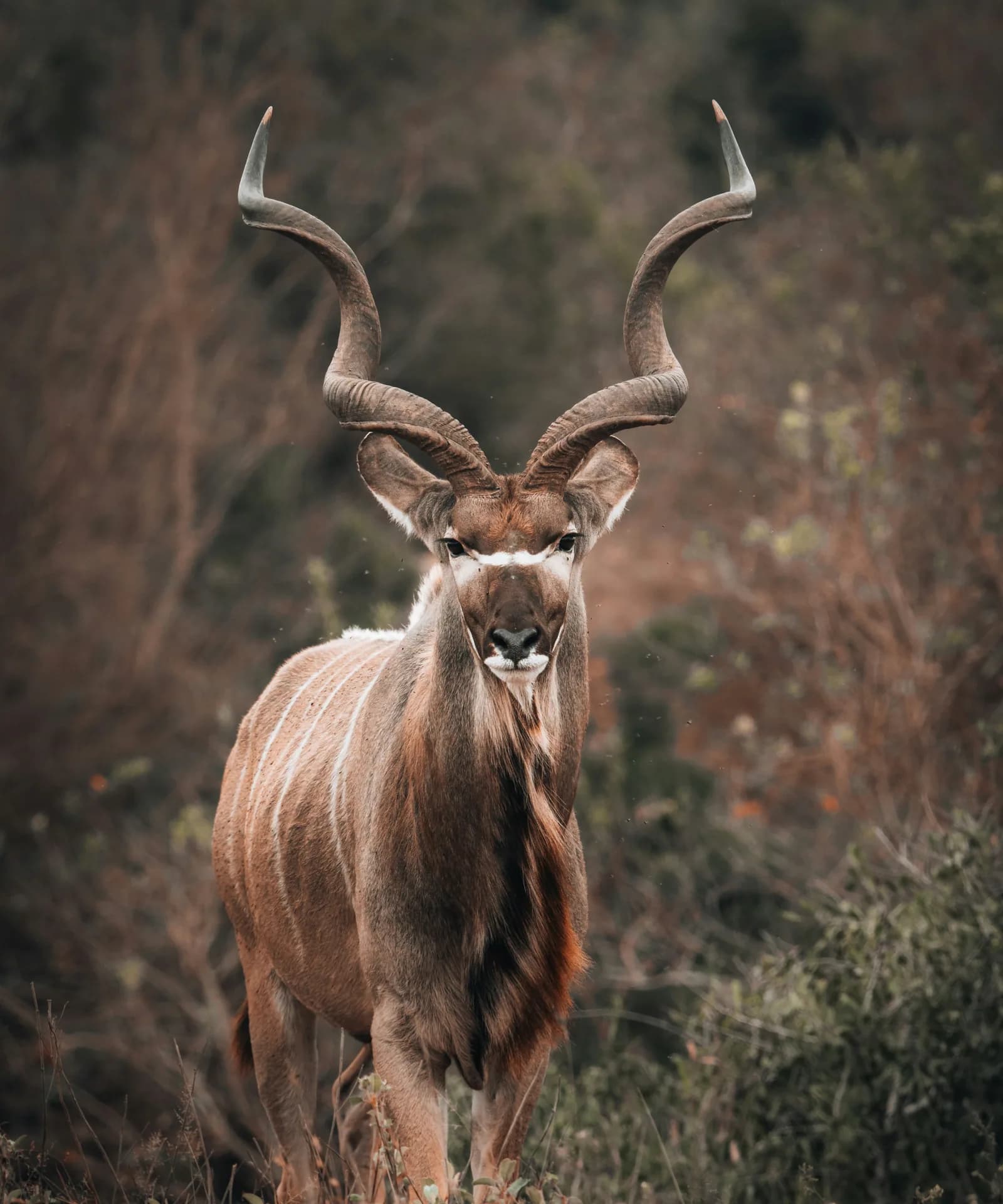

Plains game
Tsessebe
Tsessebe · Damaliscus lunatus lunatus
The fastest antelope in Africa — open-country rifle work, hartebeest-adjacent anatomy, and a precise landmark that antelope defaults get wrong.
Overview
About the species
Tsessebe are the fastest antelope in Africa — documented sustained speed of 60+ km/h over distance, with short-burst speeds higher. That's a factual detail worth knowing; it isn't the species identity. The hunt is about open-country rifle work on a medium-sized alcelaphine antelope that behaves, shoots, and fails like a red hartebeest with shorter horns.
Mature bulls run 130–160 kg on a compact, long-legged frame with a sloped topline — higher at the shoulder than the rump — similar to hartebeest but less exaggerated. The coat is dark chocolate brown with a distinctive purple sheen in good light, paler on the belly and legs. Bulls darken with age; cows stay more reddish-brown. Horns are shorter and heavier than hartebeest horns, curving outward, then up and back in a moderate lyre shape with significant basal ridging on mature animals.
Two practical points define every tsessebe hunt. First, the vitals sit forward and slightly high — a common alcelaphine trait. The landmark is not identical to hartebeest: on tsessebe the heart-lung bullet path is slightly lower and slightly more rearward than on hartebeest, because the tsessebe's shoulder slope is less steep. The middle-of-body antelope default puts the bullet in the paunch. The discipline is to hold on the leg line, one-third up from the brisket, slightly forward of where a kudu hold would be.
Second, shots are typically long. Tsessebe live on open grassland and dry savanna where cover is sparse and alarm distance is long. 200 m is a normal shot; 250–300 m is common; 100 m shots usually mean the herd hasn't detected you yet. Flat-shooting calibres and known ballistic dope matter more than heavy bullets.
Distribution in SA is narrow. Core range is the northern Limpopo bushveld, parts of the Lowveld, and selected game ranches in Mpumalanga and KwaZulu-Natal that maintain re-introduced populations. Most SA hunts happen on managed properties. The species is not common, and trophy fees reflect that.
Identification
Identifying tsessebe
Tsessebe silhouette and coat sheen are the primary field marks. ID confusion with red hartebeest on mixed properties is the main issue.
Both sexes share:
- Dark chocolate-brown coat with a visible purple sheen in oblique light
- Sloped topline — higher at the shoulder than the rump, but less exaggerated than hartebeest
- Lyre-shaped horns curving outward, then up and back, with ridged bases
- Dark face blaze from forehead to muzzle
- Dark markings on the shoulders, thighs, and lower legs
- Long-legged compact build; tail with a black tuft
Bulls:
- Darker coat with age — often near-black on the shoulders and rump in prime bulls
- Heavier ridged horn bases (8+ cm basal circumference on mature animals)
- Obvious male genitalia at close range
- Hold breeding territories on open grassland
Cows:
- Lighter, more reddish-brown coat — never turn near-black
- Thinner horn bases with less ridge development, similar horn length to bulls
- Travel in small nursery herds
Aging bulls:
- Young (1–3): reddish-brown coat, horns short (under 30 cm) and thin-based
- Prime (4–8): dark coat with purple sheen, horns 35–42 cm with heavy basal ridging
- Old (9+): coat often near-black on shoulders, horn length at peak 40–45 cm, bases fully merged, tips sometimes broomed
Common misidentifications:
- Red hartebeest — same family (Alcelaphinae), similar sloped topline and open-country habitat. Distinguishing marks: hartebeest is reddish-sandy coloured (never dark chocolate), taller at the shoulder, longer more extravagantly-curved horns, and a more exaggerated shoulder hump. Tsessebe is chocolate-coloured with the purple sheen and shorter lyre-shaped horns
- Blesbok — smaller, sandy-chestnut coat, prominent white face blaze. No real confusion at close range; at 300 m against poor light, the silhouettes can blur
- Young tsessebe vs cow — colour alone is unreliable until 3–4 years. Horn base thickness and scrotal check are the identification markers
Habitat
Where they’re found
Tsessebe are open-grassland and dry-savanna specialists across a narrow SA range. Suitable habitat is localised, which explains the species' restricted distribution.
South African distribution:
- Limpopo — northern Waterberg, northern bushveld open-grassland properties, parts of the Lowveld. Core natural range
- Mpumalanga — Lowveld and escarpment properties; limited natural populations
- KwaZulu-Natal — introduced populations on selected game ranches
- North West — introduced on managed properties
- Free State, Northern Cape, Eastern Cape, Western Cape, Gauteng — not core range; limited private-land introductions only
Most SA tsessebe hunts happen on managed game ranches in Limpopo, Mpumalanga, or KZN that carry resident breeding herds.
Habitat preferences within range:
- Open grassland and dry savanna with a good perennial grass component
- Mid-height grass with scattered trees — acceptable where the canopy is sparse
- Open vleis and pan edges — used for feeding, especially in dry season
- Avoided: thick bushveld, riverine forest, mountain country, Karoo scrub, fynbos
Water dependence is moderate — tsessebe need daily drinking water in dry season but can draw moisture from succulent grasses during the rains. Range 3–5 km from water in most conditions.
Tsessebe are selective grazers preferring mid-height perennial grasses in fresh growth. They move across large ranges following grass quality, which on unfenced properties makes them harder to pattern than hartebeest.
Altitude range in SA is 400–1,500 m.
Behavior
Behavior & herd structure
Tsessebe social structure centres on small territorial herds and solitary bulls. Nursery herds of 6–15 cows with young are associated with a single territorial bull, and bachelor bulls form loose aggregations at the periphery of good habitat.
Activity pattern: diurnal with morning and late-afternoon feeding peaks. Midday is spent bedded in light shade, typically on higher ground with long sight lines. Night movement is minimal.
Rut: concentrated February–April in most SA range. Territorial bulls mark their ground, defend against rivals, and vocalise with a low grunt-snort during the peak. Rutting bulls are more predictable (fixed territory, patrolling behaviour) and slightly easier to locate.
Behavioural traits for the hunter:
- Long alarm distance. Tsessebe detect threats at distance thanks to excellent eyesight and the open habitat. A herd at 300 m will often already know you're there. Stalking below that range is the core challenge
- Standing-watch posture. On alarm but not committed to flight, tsessebe stand in a loose line facing the threat, ears forward. This is the opportunity window — 15–40 seconds typically — before they run
- Straight-line retreat. On committed alarm, tsessebe run in a straight line across open country at sustained speed, often covering 1 km before stopping to re-assess. Second-chance shots on the same herd are rare; move on if the first opportunity is missed
- Bull-at-the-flank. Territorial bulls patrol the flank or trail the herd rather than leading. Mare-led movement means the lead animal is not the target
- Termite-mound use. Tsessebe bulls regularly stand on termite mounds to survey their territory and watch for rivals or threats. A bull standing prominent on a mound is an opportunity — he's broadside, stationary, and usually alone
- Alarm snort. Sharp nasal snort followed by head-up posture. Often two or three snorts in sequence before the herd commits to flight
Hunting
Hunting tsessebe
Common errors:
- Antelope-default behind-shoulder aim. Tsessebe vitals sit forward and slightly high. A middle-of-body hold — the impala or kudu default — puts the bullet in the paunch. The landmark is the leg line, one-third up from the brisket, slightly forward of a kudu hold. This is the same error pattern as on red hartebeest but with a slightly different landmark
- Confusing with red hartebeest at distance. On properties holding both species, the sloped topline and open-country habitat are shared. Check coat colour and horn shape before firing: tsessebe is chocolate with a purple sheen and shorter lyre-shaped horns; hartebeest is sandy-reddish with longer, more extravagantly-curved horns
- Rushing the shot on the standing-watch window. The 15–40 second opportunity tempts hunters to pull the trigger before the sight picture is settled. A missed shot at 250 m on a tsessebe herd almost never gets a follow-up. Take the shot when the hold is steady; don't rush
- Under-estimating distance. Open country telescopes range — a bull that looks 150 m is often 220. Ranging with a rangefinder before the stalk settles is standard. Known dope at 100, 200, 300, 400 m is standard setup
- Shooting at a bunched herd. Tsessebe bunch tight under alarm. Bullets pass through one animal into the next. Wait for target separation
Distances. Typical shot is 180–280 m. 100 m shots are rare and usually mean the herd hasn't detected you. 300–350 m is within reach of a competent rifleman on a steady rest.
Rifle setup. Floor is .270 Winchester with 140-grain premium bullet — genuinely adequate on 150 kg animals at typical distances. Sweet spot is 7mm Remington Magnum / .30-06 / .308 Winchester with 150–180 grain premium bullets. Flat-shooting calibres are preferred over heavy-for-calibre bullets given the distance profile. Bonded bullets are welcome but not essential at this body size.
Zero 200 m with known drops to 400 m. Most shots are off sticks in standing or sitting position. Practise at distance before the hunt; known dope is the difference between a 250 m heart shot and a 250 m gut shot.
What to expect from your PH. Tsessebe hunts are open-country glassing-and-stalking affairs. Expect: early start for the morning feeding window, long drives between observation points, glassing from high ground for herds, planned stalks that use terrain folds to close distance. The PH will almost always rangefind before the shot — trust the number rather than your eye. Shots past 250 m are normal; the PH's calibre and bullet recommendations should reflect that.
Recovery on a well-hit tsessebe is usually within 50–150 m across open grassland. Recovery on a poorly-hit tsessebe is a long track across open country — the animal can cover a kilometre before stopping. A good first shot matters more on tsessebe than on most plains-game species simply because of the distance involved in follow-up.
Conservation
Conservation status
Tsessebe are listed as Least Concern on the IUCN Red List at the species level, though some range states have seen regional declines. Southern tsessebe — the SA subspecies — is stable in SA on public and private land combined.
SA populations are mostly private-land and re-introduced. Free-ranging natural populations exist in Kruger and a handful of public reserves, but the bulk of SA tsessebe are on Limpopo, Mpumalanga, and KZN game ranches that established resident breeding herds over the past 30 years. Re-introduction programmes have meaningfully expanded SA's tsessebe range beyond the narrow natural distribution.
The hunting industry's role here is the standard SA managed-species story: trophy-fee economics make the species financially viable for private landowners to maintain, and properties invest in habitat (grass management, water points) specifically to hold viable herds. Without that incentive the private-land tsessebe population would be substantially smaller.
Regional concerns exist across the wider tsessebe range — populations in some SADC states have declined due to poaching and habitat loss — but SA's managed-population approach is among the more successful regional conservation models for the subspecies.
Subspecies note: tsessebe (D. l. lunatus) is distinct from topi (D. l. jimela) and korrigum (D. l. korrigum) which occur in East and West Africa respectively. SA hunts are strictly on southern tsessebe. SCI and RW scoring is by subspecies category.
Shot placement
Where to place the shot
Always know your target anatomy before pulling the trigger. These are reference landmarks for ethical, humane kills. Conditions, distance, and animal posture change everything.
Broadside
Heart-lungLandmark: Vertical line up from the back of the front leg, one-third up from the brisket. Slightly forward of the leg-line for a heart-anchor hit.
The defining tsessebe landmark. Middle-of-body hold is a paunch shot. A .270-class premium bullet through this point anchors cleanly at typical distances.
Quartering-away
Heart-lungLandmark: Aim at the far-side shoulder joint. Entry through the near ribs behind the near shoulder.
Workable at moderate angles (up to ~30°) with a premium bullet. The angle carries through both lungs and into the far shoulder for anchor.
Quartering-toward
Heart-lungLandmark: Near-side shoulder joint, on the leg line. Angles through the near lung into the off-side chest.
Tight margin at 250 m+ tsessebe distances. Pass in strong crosswind; wait for broadside on the next presentation.
Frontal
Heart-lungLandmark: Centre of the chest at the sternum notch where neck meets brisket.
Available on a stopped head-up bull during the standing-watch alert. Bonded or premium bullet in .270 class or larger. Not a shot past 200 m.
Going-away
No ethical shotLandmark: No landmark. A going-away tsessebe presents rump and gut.
Don't take going-away shots. The sustained speed means a gut-shot animal runs 1 km+ across open grassland before stopping. Wait for the herd to turn.
High-shoulder anchor
High-shoulderLandmark: Top of the shoulder blade, one-quarter down from the spine line.
Useful when the herd is about to commit to long-distance retreat. Breaks the spine and anchors in place. Destroys shoulder cape.
Available at
Farms offering tsessebe
No farms currently offering this species on SkietNet.