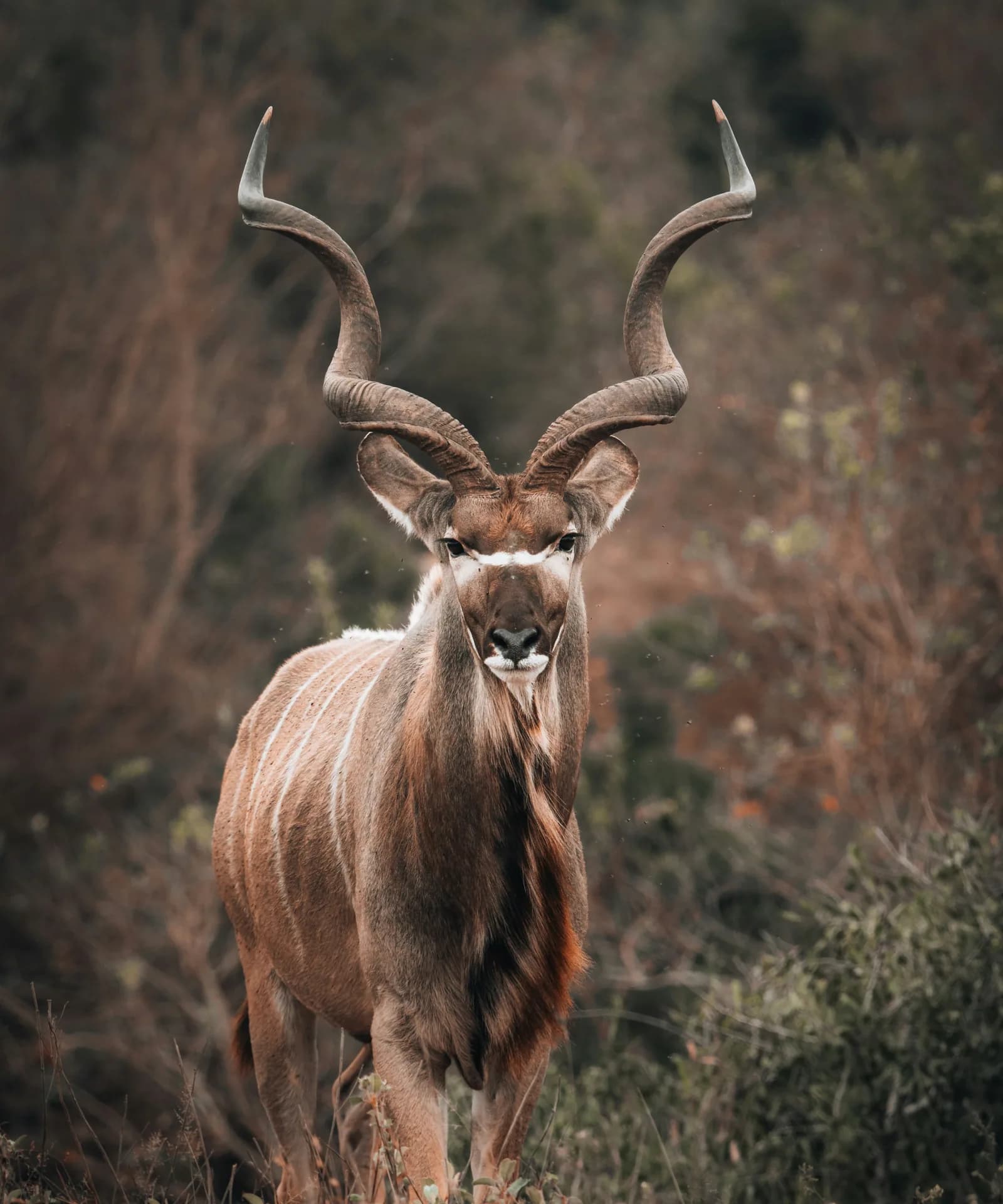

Plains game
Steenbok
Steenbok · Raphicerus campestris
Eleven kilos of antelope that freezes at 30 m, bolts at the last second, and tempts every hunter into a bad running shot.
Overview
About the species
Steenbok are the smallest antelope most SA hunters encounter regularly. An adult ram runs 10–16 kg — about the weight of a small dog — but carries itself like a miniature kudu, long-legged and alert. They’re pair-bonded, territorial across small ranges (3–7 hectares), and genuinely widespread: all nine SA provinces hold them, from the Karoo shrubveld to the KZN thornveld, from Kalahari sandveld to Highveld grass edges. The only places they’re absent are dense forest, deep wetlands, and open grassland with no cover.
Two things about the hunt define the article. First, steenbok are taken as targets of opportunity more often than as planned quarry. A hunter on a multi-day plains-game hunt for kudu or gemsbok will encounter steenbok on most mornings — and good hunters take the ones that present, because the meat is excellent and the small-antelope tally rounds out the trip. Dedicated steenbok hunts exist but are rare; most steenbok come out of opportunity windows on broader hunts.
Second, the alarm response shapes every shot decision. Steenbok freeze when they sense movement but haven’t identified threat — often at 30–50 m, in the open, completely still. That freeze ends suddenly: a single bound followed by a zig-zag sprint through cover, tail flat and body low. Hunters see the freeze window and think there’s time; there isn’t. Either you’re ready to shoot in the first seconds, or the ram will bolt and you’ll be looking at the bad idea of a running shot.
Trophy measurement is modest — ram horns are 7–14 cm, straight upright spikes with a slight forward lean. Rowland Ward and SCI both list the species but the scoring numbers are among the smallest in the small-antelope category. Most hunters don’t target steenbok for the horn; they take them for the meat, the experience, and the check against the plains-game list.
Identification
Identifying steenbok
Steenbok are identifiable on size, posture, and habitat combined.
Rams:
- Small body (10–16 kg), slender build
- Rich rufous-brown coat, lighter on the flanks and white on the belly
- White underside to the tail
- Large dark eyes — disproportionately large, the most recognisable face feature at close range
- Large rounded ears, held upright when alert
- Short straight upright horns with a slight forward lean, 7–14 cm
- White chin patch and white eye ring
- Long legs relative to body — built for sprinting in cover
Ewes:
- Same coat and body markings as rams
- Hornless (no exceptions in SA populations)
- Slightly smaller on average but the difference is marginal
Aging rams in the field:
- Young (1–2 years): horns 4–7 cm, thin, smooth
- Prime (2–5): horns 9–13 cm, slight basal ridging, body filled out
- Old (5+): horns at maximum length, often broomed at tips, basal ridging more pronounced
Common misidentifications:
- Common (grey) duiker. The key ID mistake. Common duiker are slightly larger (~20 kg vs steenbok 12 kg) but more importantly duiker horns lean forward markedly (nose-forward), while steenbok horns stand upright. At distance, the horn angle is the reliable field mark. Duikers also carry a dark forehead tuft; steenbok don’t
- Cape grysbok (Raphicerus melanotis). Different species, coastal Western Cape and southern Cape only. Grysbok are grizzled (hair mix of white-tipped and dark hair), while steenbok are uniformly rufous. If you’re outside the Western Cape coastal belt, it’s a steenbok
- Sharpe’s grysbok (Raphicerus sharpei). Different species, Limpopo Lowveld and Mpumalanga. Smaller body, more grizzled coat, rarely encountered
- Oribi. Same size class but oribi have darker legs with a distinctive black knee-mark, a short bushy black-tipped tail, and longer-looking necks. Oribi prefer open grassland; steenbok prefer broken cover
Habitat
Where they’re found
Steenbok are among the most habitat-flexible SA antelope. The list of places they occur is easier than the list of places they don’t.
South African distribution: all nine provinces carry steenbok populations in suitable habitat. They’re present on virtually every private-game property that has some cover and is not pure wetland or dense forest.
Habitat preferences within range:
- Bushveld with grass-and-shrub mosaic — the single best steenbok habitat. Thornveld, mixed woodland, acacia scrub
- Karoo shrubveld — widespread
- Highveld grassland with cover patches — present where cover breaks up the open grass
- Kalahari sandveld — surprisingly common in the sparse-cover arid zones
- Riverine fringes and agricultural margins — they colonise disturbed-ground edges readily
- Avoided: dense forest, open flat grassland with no cover, deep wetland, very steep rocky terrain
Water independence is strong. Steenbok can go weeks without drinking, extracting moisture from browse. They’re particularly well-adapted to Karoo and Kalahari conditions where seasonal water dictates movement for most other species.
Altitude range is broad — sea level to around 1,800 m. Both heat-tolerant and cold-tolerant within reason.
Density varies by property management but steenbok are rarely absent from suitable habitat. A well-kept bushveld farm can carry 10–20 steenbok per 100 hectares without competing significantly with larger species for browse, which is one reason they appear on every plains-game hunt list as a no-extra-effort inclusion.
Behavior
Behavior & herd structure
Steenbok are pair-bonded and strictly territorial. A ram and ewe hold a territory of 3–7 hectares, mark it with dung middens at prominent points, and don’t tolerate other steenbok in it. Unlike most plains game, there are no steenbok herds — every steenbok you see is either a single animal (member of a bonded pair) or, rarely, a mother with a calf.
Activity pattern: crepuscular with significant dawn and dusk activity, reduced daytime movement. Peak windows are first light to 09:00 and 16:30 to dark. Midday is typically bedded in shade, often within 100 m of a preferred feeding spot. Night activity is substantial but not relevant for daylight hunting.
Rut: year-round. Steenbok pair-bonds are stable for years; rut behaviour in the territorial-display sense isn’t as concentrated as in herd species. Breeding peaks exist but are loose.
Behavioural traits for the hunter:
- Freeze response. The defining behaviour. A steenbok that has sensed movement will freeze, ears forward, eyes locked on the suspected source. The freeze can hold for 30–60 seconds. If you’re ready to shoot, you have a window; if not, the freeze ends in a bolt
- Bolt pattern. The freeze ends with a single powerful bound, then a zig-zag sprint through cover. They don’t run straight; they cut to break the pursuing sight line. Running shots are almost always missed or bad hits
- Territory predictability. A resident pair uses the same feeding spots, bedding sites, and dung middens across months. A PH who knows the property has a map of where the resident rams will be at which time. The daily-routine predictability is the hunting advantage
- Small-game-trail travel. Steenbok use specific narrow paths between bedding, feeding, and water areas. The paths are visible once you know what to look for. Blinds on these trails produce
- Vocal communication. Soft "meh" bleats between paired animals at short range — not an alarm call, but useful for locating a bonded animal when the other is visible
Hunting
Hunting steenbok
Common errors:
- Taking the running shot after the bolt. Every SA hunter has at least one story of a bad running shot on a steenbok. The temptation is real — the animal ran at 30 m — but the zig-zag sprint makes the shot almost guaranteed marginal. Don’t shoot at a running steenbok. Mark the direction, pause, look for the next pair 500 m on
- Rushing the freeze. A frozen steenbok at 40 m is not an automatic shot — it’s a window that can close. But rushing a set-up often misses the shot entirely. If you need 5 seconds to get on sticks or a rest, take them; the freeze holds 30 seconds or more in most cases
- Over-calibre meat damage. A 180-grain bullet through an 11 kg animal at 80 m destroys eating meat on a cape and haunch. Match calibre to body mass — .22 Hornet to .243 class, not bigger
- Confusing with duiker at distance. Trophy fees and legal protections differ between steenbok and common duiker. Check horn orientation (steenbok straight up, duiker forward-curving) and confirm with your PH before committing
- Shooting low on the brown body. The steenbok kill zone is above the dark side line. A visual middle-of-body hold puts the bullet too low. Aim at the upper third of the brown, at the shoulder line
Distances. Typical shot is 40–120 m. A 30 m shot is common when you walk into a bedded or feeding ram on a quiet morning. Past 150 m is rare — steenbok cover doesn’t usually give you the line of sight for it, and the target is small enough that ballistic precision matters.
Rifle setup. Floor is .22 Hornet / .222 Remington with soft-point bullets — entirely adequate for a 12 kg animal. The practical sweet spot for most SA hunters is .223 Remington / .243 Winchester with 55–100 grain soft-point or premium bullets. Anything heavier is meat-destroying without being more effective. A good steenbok rifle is the same low-recoil setup that works for springbok — flat-shooting, precise, modest grain.
Shotgun with appropriate slug or large shot is also used on some properties, particularly for young or hunter-educated groups. Bow hunting works from blinds or tree stands over game trails, inside 25 m, with 40 lb+ draw weight.
What to expect from your PH. Most steenbok come as bonus animals during broader plains-game hunts. On a kudu hunt, the PH will call a halt at the first steenbok opportunity and ask if you want to take it — the answer is almost always yes, because the next one may be an hour away and the current one is here. Dedicated steenbok hunts exist but are rare. Expect: walking the feeding-ground edges at first light, watching for the freeze, taking the shot off sticks at 60–100 m.
Conservation
Conservation status
Steenbok are listed as Least Concern on the IUCN Red List. The species is abundant and stable to increasing across southern Africa. No CITES listing.
Populations are robust because of two factors. First, the habitat flexibility — they thrive on land used for cattle grazing, cropping margins, and game farms alike, meaning their range isn’t tied to strict conservation-protected areas. Second, the pair-bonded territorial structure means mature animals continuously replace each other in a given patch of habitat; offtake of one resident is quickly backfilled by an adjacent animal.
Private-land game-farm economics affect steenbok less directly than species like kudu or impala. Steenbok are low-fee animals that contribute small amounts to hunting revenue, but they occur on every property that has suitable habitat regardless of whether they’re actively managed. The species doesn’t require dedicated conservation investment — it benefits from general veld maintenance on properties that have other priorities.
No SA subspecies concerns. Cape grysbok (R. melanotis, Western Cape coast) and Sharpe’s grysbok (R. sharpei, northern bushveld) are separate species in the same genus with distinct ranges and record-book categories — don’t confuse them with steenbok when planning a hunt.
Annual offtake is substantial in biltong-hunting terms — steenbok are widely harvested for meat across SA — but the numbers don’t threaten populations given the high recruitment rate and habitat flexibility. Trophy hunting is a small proportion of total offtake.
Shot placement
Where to place the shot
Always know your target anatomy before pulling the trigger. These are reference landmarks for ethical, humane kills. Conditions, distance, and animal posture change everything.
Broadside
Heart-lungLandmark: Vertical line up from the back of the front leg, at the shoulder line where the brown coat transitions from flanks to body. Upper third of the brown, not middle.
Small target, high line. The steenbok kill zone is higher in the chest relative to body size than on larger antelope. Holding at visual middle-of-body is low. Aim at the upper brown, just below the darker shoulder line.
Quartering-away
Heart-lungLandmark: Aim at the far-side shoulder joint. Entry through the near ribs behind the near shoulder.
Workable when the ram walks past rather than freezing square-on. Use soft-point; the small body allows light bullet construction but the angle requires the bullet to travel through ribs into the far shoulder.
Quartering-toward
Heart-lungLandmark: Near-side shoulder joint.
Tight margin at typical close-cover distances. Acceptable at 30–60 m; at 100 m+ the small target makes this shot low-percentage in crosswind.
Frontal
Heart-lungLandmark: Centre of the chest where the neck meets the brisket.
Common when a frozen ram squares up head-on to look at you. Thin chest, easy penetration, small target. Hold the sternum notch and squeeze — don’t drift.
Going-away
No ethical shotLandmark: No landmark. A going-away or running steenbok is not a shot.
The classic steenbok mistake. After the freeze breaks the ram bolts and zig-zags through cover. A shot at this moment is gut territory or worse. Mark the direction and walk on.
High-shoulder anchor
High-shoulderLandmark: Top of the shoulder blade, one-quarter down from the spine line.
Rarely needed on steenbok because they anchor cleanly on a good heart-lung. If terrain or cover behind the animal is bad (thick scrub that would hide the run), the high-shoulder shot drops them in place. Destroys shoulder cape.
Available at
Farms offering steenbok
No farms currently offering this species on SkietNet.