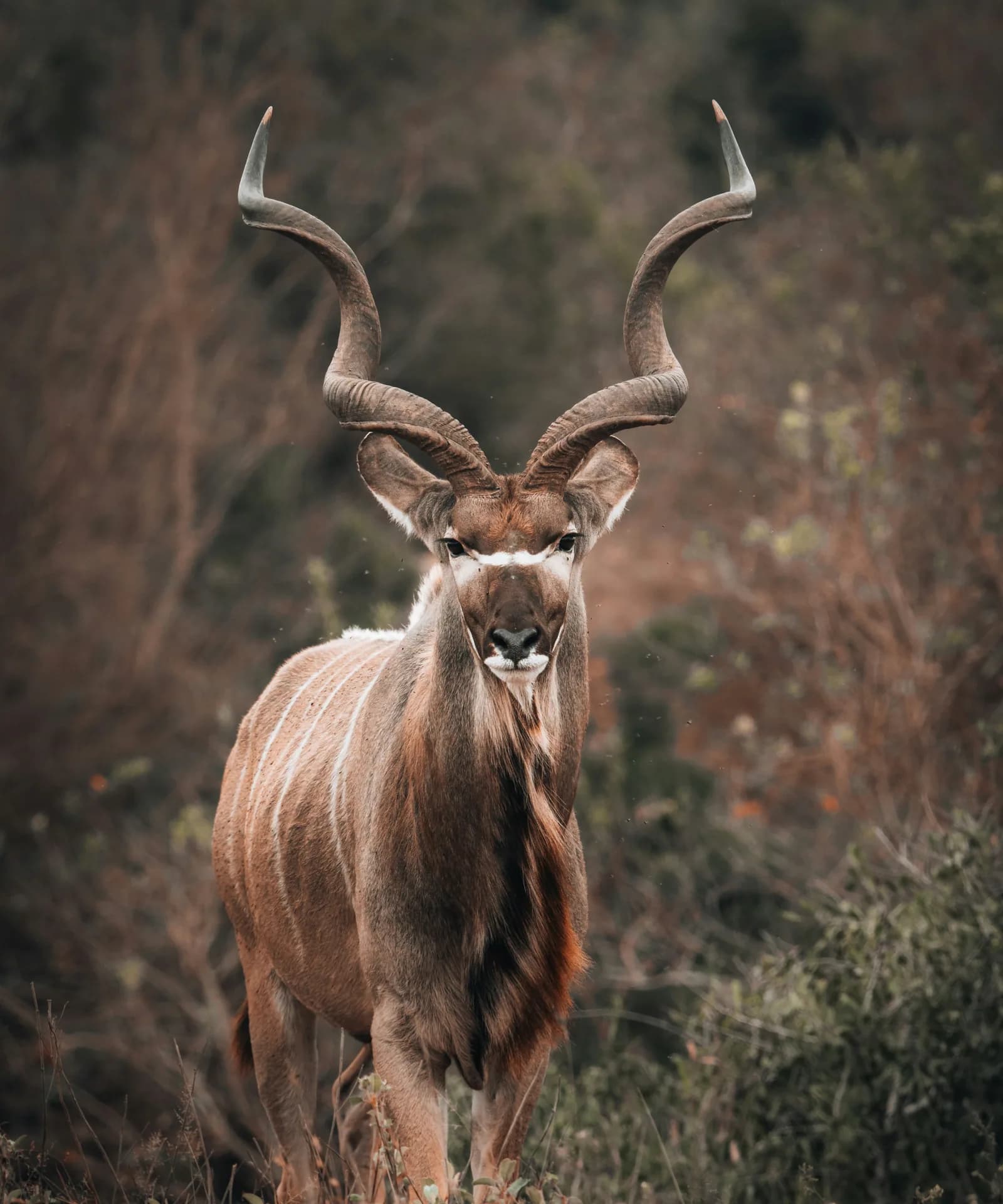

Plains game
Springbok
Springbok · Antidorcas marsupialis
Small target, long shots, and a herd that explodes into vertical leaps at the first wrong move — Karoo rifle discipline condensed into 40 kg of animal.
Overview
About the species
Springbok are the smallest huntable plains-game animal in South Africa and the national animal of the country. An adult ram runs 30–50 kg; a ewe sits 30–44 kg. They’re built for arid open country — lean, long-legged, adapted for speed and visibility. The coat is a warm cinnamon-brown with a sharp white belly, dark side stripe, and white face with a dark blaze from horns to nose. On alarmed animals the skin fold along the back opens to expose a crest of long white hair; this display is part of the pronking behaviour that gives the species its name.
Pronking is the defining field behaviour. When alarmed, springbok perform repeated vertical stiff-legged leaps — up to 2 metres vertical — with the back arched, legs straight, and the white dorsal crest fanned open. It’s cascading: one animal starts and the whole herd follows within seconds. A pronking herd is ungettable on that approach — the shot window has closed and the herd is committed to distance. Stalking discipline matters more on springbok than on most other plains game for this reason: a single bad step ends the hunt.
Distribution is arid-dominant. Core range is the Karoo (Northern, Western, Eastern Cape), the Kalahari fringe in the Northern Cape, and the Free State grassland. They’re absent from the Lowveld, KZN bushveld, and the fynbos of the southern Cape. Private-land populations have expanded on open-country game farms across the country but the species really thrives only in its native arid-to-semi-arid habitat.
Both sexes carry horns. Rams have thick, heavily ridged, lyre-shaped horns; ewes carry lighter, thinner horns of similar shape but with less mass at the base. Trophy scoring favours rams by a wide margin because of the basal circumferences, though exceptional ewes do score into the record books. Colour morphs — white springbok, black springbok, copper springbok — are farm-bred variants of the same species, selectively bred for colour rather than wild genetics; they score in the same SCI category as common springbok but traditionalist hunters consider them farm stock rather than proper trophies. Take a position before booking.
Identification
Identifying springbok
Springbok are unmistakable at any practical distance. No other SA antelope has the same combination of small body, cinnamon coat with sharp white belly, and the opening dorsal crest when alarmed.
Both sexes share:
- Cinnamon-brown upper body with a sharp, horizontal transition to a pure white belly
- Dark brown horizontal side stripe from shoulder to hip, running along the line where brown meets white
- White face with a dark blaze from between the horns to the black muzzle
- Dark ear tips
- Dorsal crest — a fold of skin along the mid-back that opens when alarmed, exposing a long white hair crest. This is the pronking display
- Long, slender legs
- Short, wedge-shaped tail, dark-tipped
Rams (trophy markers):
- Thick, heavily ridged horn bases. The single most reliable sex marker
- Slightly heavier through the neck and shoulders
- Dark face mask often more pronounced in mature rams, especially during rut
- Horn length 35–48 cm along the lyre curve in mature animals
Ewes:
- Thinner, smoother horn bases. Less ridging, narrower overall
- Leaner body, slightly smaller on average
- Less-developed face mask
- Horn length 22–35 cm; the lyre curve is present but less pronounced
Aging rams in the field is horn-base work. Young rams (1–2 years) carry short, thin horns with minimal ridging; prime rams (3–6) show the full lyre and deep basal ridges; old rams (7+) often carry broomed tips and heavily gnarled bases. The dark face mask deepens with age and is a useful at-distance age cue.
Colour morphs — white, black, copper. Genetically the same species, selectively bred on fenced farms. White springbok are leucistic (pale coat, still with darker markings); black springbok are uniformly dark chocolate-brown throughout; copper springbok are a deeper red-brown than common springbok. All three morphs score in the same SCI and Rowland Ward categories as common springbok. Whether they count as "real" trophies comes down to personal preference — they are genuine springbok, but they’re products of selective breeding rather than wild variance.
Common misidentifications are rare. Their silhouette and markings are distinctive enough that at any reasonable range there’s no confusion with other SA antelope.
Habitat
Where they’re found
Springbok are arid-country specialists. They evolved for open grassland and semi-desert and don’t thrive in bushveld, forest, or riparian habitat. Visibility, short-grass feeding, and drought-adapted browse define their range.
South African distribution:
- Karoo — Northern, Western, Eastern Cape — core SA range and historic stronghold. Open shrubveld and grass-shrub mosaic properties carry the highest densities
- Northern Cape — Kalahari and Orange River basin — excellent habitat, strong populations both in Kgalagadi Transfrontier Park and on private properties
- Free State — western and central grassveld — good populations on the more arid-adjacent farms
- Eastern Cape — inland Karoo — established populations
- North West — arid western parts — present
- Western Cape — inland Karoo east of the fynbos line — present on open-country properties
- Limpopo, Mpumalanga, KZN — introduced populations on open-country farms; not a natural fit for these provinces’ wetter habitats and densities are low
Absent from the Lowveld, the fynbos, the coastal forest belts, and any densely-wooded or riparian habitat.
Habitat preferences within range:
- Open grassland and short shrubveld — prime feeding; they’re grazer-browsers with strong grass preference in flush periods
- Kalahari short grass and dune flats — historically and currently strong populations
- Karoo shrub-grass mosaic — classic habitat; herds of 30–150 common here on large properties
- Avoided: woodland, bushveld, tall-grass rangeland where visibility is limited
Water dependence is moderate to low. Like gemsbok, springbok can go extended periods without drinking in cool conditions, getting moisture from browse. In hot dry seasons they’ll concentrate near water, but they’re not obligate daily drinkers.
Altitude range is 500–2,000 m. They tolerate Highveld winters and Karoo summer heat well; temperature is not a limiting factor within their preferred open-country habitat.
Behavior
Behavior & herd structure
Springbok herd structure is flexible and density-dependent. In productive habitat herds can run from 50 to 500+ animals; on sparser country herds of 20–40 are more typical. Historically, springbok performed large migratory movements (the "trekbokke") involving hundreds of thousands of animals; those migrations ended with fencing by the late 19th century. Contemporary herds are smaller but still move significant distances within properties following rain and new grass.
Activity pattern: diurnal with dawn and dusk peaks. In summer heat they bed in light shade during midday; in winter they graze through most of the day. Night activity is minimal; they bed down in the open at sunset and don’t range much after dark.
Rut: two peaks per year on most SA populations, roughly December–January and again June–July. Territorial rams hold small stands (30–100 m diameter) around good forage and water, marking with urine and dung middens. Dominant rams vocalise with a nasal bleat and engage in head-to-head pushing contests.
Behavioural traits for the hunter — pronking is the defining one:
- Pronking. Vertical stiff-legged leaps up to 2 metres, back arched, dorsal crest fanned open. Cascading across the herd within seconds. Once the herd pronks, the hunt on that group is over for at least 30 minutes — they commit to distance and won’t settle where you can get to them
- Settle and stop. After a pronk-sequence run of 400–800 m the herd typically stops in a new spot and looks back. The stop is a window; the animals are keyed up and ready to pronk again
- Sentry behaviour. Like impala, springbok herds maintain 360° sentry coverage. A herd with 100 animals has 100 heads turning every few seconds
- Herd geometry shift. Springbok herds change shape rapidly — flowing, running, clustering, dispersing. The ram you want in the herd at one glance may be in a different position 30 seconds later. Pick the target, watch continuously, take the shot when the target stops
- Alarm snort. A sharp nasal snort before pronking kicks off. The first hunter-hint is usually the snort, followed within a second by the leaps. You don’t get to "almost" take the shot before the pronk starts
Hunting
Hunting springbok
Springbok hunting is the precision-over-power expression of South African plains game. Small target, long shots, open country, and a herd that evaporates in seconds if you give them reason.
Distances. Typical shot is 180–300 m. Open Karoo ground pushes most shots past 200 m; a 100 m shot usually means the ram hasn’t detected you yet. 350 m+ shots are doable with the right rifle and rest, but the small target size (springbok kill zone is roughly 15 cm diameter) makes wind drift unforgiving.
Rifle setup. Calibre floor is .243 Winchester / 6mm Creedmoor with a 90–105 grain premium bullet — this is a genuine ethical floor, not aspirational. A .270 Winchester or 6.5 Creedmoor with a 130–140 grain premium bullet is the sweet spot for typical springbok shot distances. Over-calibre on springbok means meat damage rather than reliability gain — a 180-grain .308 through a 40 kg ram wastes a cape and a haunch.
The emphasis on premium bullet is important. Springbok chest cavity is small; a cup-and-core bullet that expands too aggressively can deliver massive shock damage that wrecks eating meat on an animal prized for its biltong. A controlled-expansion bullet goes through clean.
The right setup for this species is a flat-shooting rifle with a good scope and proper long-range dope. The .243 / 6mm class excels here because recoil is low (critical for precision on a small target), the bullets are flat-shooting to 400 m, and the meat damage is manageable.
What to expect from your PH. Springbok hunts are slow-paced glassing-and-stalking exercises interrupted by fast windows. Expect: drive between high-ground observation points, spend significant time on the glass locating target rams within herds, plan long approaches across open ground using terrain folds, set up at 200–300 m on a rest, wait patiently for the target ram to stop broadside and clear of the herd. The glassing takes far more time than the shooting.
Common errors:
- Rushing a shot on the first animal that stops after a pronk sequence. Once a herd has pronked and then stopped to look, the instinct is to take the first clear target quickly. The stopped animal is keyed up and ready to move again; the odds of a clean shot are worse than if you wait 60–90 seconds for the herd to settle a bit more. Wait
- Holding under the white belly line. Springbok body appears larger than it is because the white belly has sharp contrast with the brown back. The kill zone is above the side stripe, not centred on the visual middle of the body. Hold above the side stripe, at the lower edge of the brown
- Over-ranging in crosswind. A 350 m shot on a 40 kg animal in a 10 m/s crosswind drifts 12–18 inches with a 6mm-class bullet. At that distance the miss margin is zero. Know your dope or close the distance
- Shooting a young ram thinking the horns are bigger than they are. Horn length is hard to judge at 300 m without good optics. Basal thickness is the reliable trophy marker — let the PH make the call on which ram to take
- Taking a shot at a pronking animal. Never. The leap trajectory is unpredictable and the wound pattern is certain to be bad. Wait for the pronk sequence to finish and the animal to stop
Conservation
Conservation status
Springbok are listed as Least Concern on the IUCN Red List. SA populations are stable to increasing; the species is the national animal of South Africa and is widely distributed across arid and semi-arid habitats in the country. No CITES listing.
The conservation history is one of the success stories of private-land wildlife management in southern Africa. Historical populations were in the millions during the 19th-century trekbokke migrations; fencing, hunting, and rinderpest reduced numbers through the late 1800s and early 1900s. Private-land game-farm economics through the 20th century, plus public-land protection in the Kgalagadi, Karoo, and Mountain Zebra National Parks, rebuilt numbers to comfortably sustainable levels. Annual trophy harvest is a small fraction of the total offtake — biltong hunting takes most of the volume because of the species’ excellent meat quality — and numbers have been climbing for decades.
Subspecies note: SA springbok (Antidorcas marsupialis marsupialis) is the common subspecies. Two other subspecies exist: Angolan and Kalahari, neither of which meaningfully affect SA trophy records.
Colour morphs bear their own conservation discussion. White, black, and copper springbok are the products of selective breeding on fenced farms, not natural variation, and they’ve been controversial. Some geneticists argue that the selective breeding reduces genetic diversity in the farmed populations; wildlife managers on traditional properties often refuse to introduce them to preserve the common genetic stock. SCI and Rowland Ward score the morphs as common springbok, but the record-book norm is to note colour variance. Whether you consider a black springbok a legitimate trophy or a farmed curiosity is a personal call — the animal is genetically the same species but the origin is different.
Shot placement
Where to place the shot
Always know your target anatomy before pulling the trigger. These are reference landmarks for ethical, humane kills. Conditions, distance, and animal posture change everything.
Broadside
Heart-lungLandmark: Vertical line up from the back of the front leg, at the lower edge of the brown body colour (just above the dark side stripe and the white belly line). Not at the visual centre of the body — the white belly makes the kill zone look lower than it is.
Standard plains-game position but with a critical visual correction. The sharp brown-to-white colour contrast below the side stripe makes hunters drift the hold low, which goes through the belly. Hold at the brown-edge above the stripe.
Quartering-away
Heart-lungLandmark: Aim at the far-side shoulder joint. Entry through the near ribs behind the near shoulder.
Excellent presentation on a walking ram. Springbok are small enough that even a lightly-built 6mm-class bullet will pass cleanly through both lungs into the off-side shoulder at typical distances. Premium bullet still required for clean meat-damage profile.
Quartering-toward
Heart-lungLandmark: Near-side shoulder joint. Angles through the near lung into the off-side rib cage.
Viable but narrower margin than on larger antelope because the kill zone is already small. Pass on this shot past 250 m — wind drift and the tight target combine to make missed shots more likely than connected ones.
Frontal
Heart-lungLandmark: Centre of the chest at the sternum notch where neck meets brisket.
Available on a stopped head-up ram. Springbok chest is modest and a .243 / 6mm bullet penetrates easily. Don’t take past 200 m because the kill zone narrows dramatically from that angle.
Going-away
No ethical shotLandmark: No landmark. A going-away springbok presents rump and gut; the narrow spine angle means marginal hits are gut hits.
Don’t take a going-away shot on springbok. The stop-and-settle behaviour after a pronk sequence means a better presentation is almost always seconds or minutes away; wait. Wounded springbok in open Karoo country are a long recovery.
High-shoulder anchor
High-shoulderLandmark: Top of the shoulder blade, one-quarter down from the spine line. Breaks upper vertebrae.
Rarely needed on springbok; they anchor cleanly on a proper heart-lung shot. Reserve for follow-up on a poorly-hit animal running for cover. Destroys shoulder cape, which matters on an animal where a full mount is a common trophy choice.
Available at
Farms offering springbok
No farms currently offering this species on SkietNet.