
Plains game
Sable Antelope
Swartwitpens · Hippotragus niger
The benchmark SA trophy — glossy black bull, swept-back horns, dangerous when wounded, expensive when missed. Calibre discipline and first-shot commitment are everything.
Overview
About the species
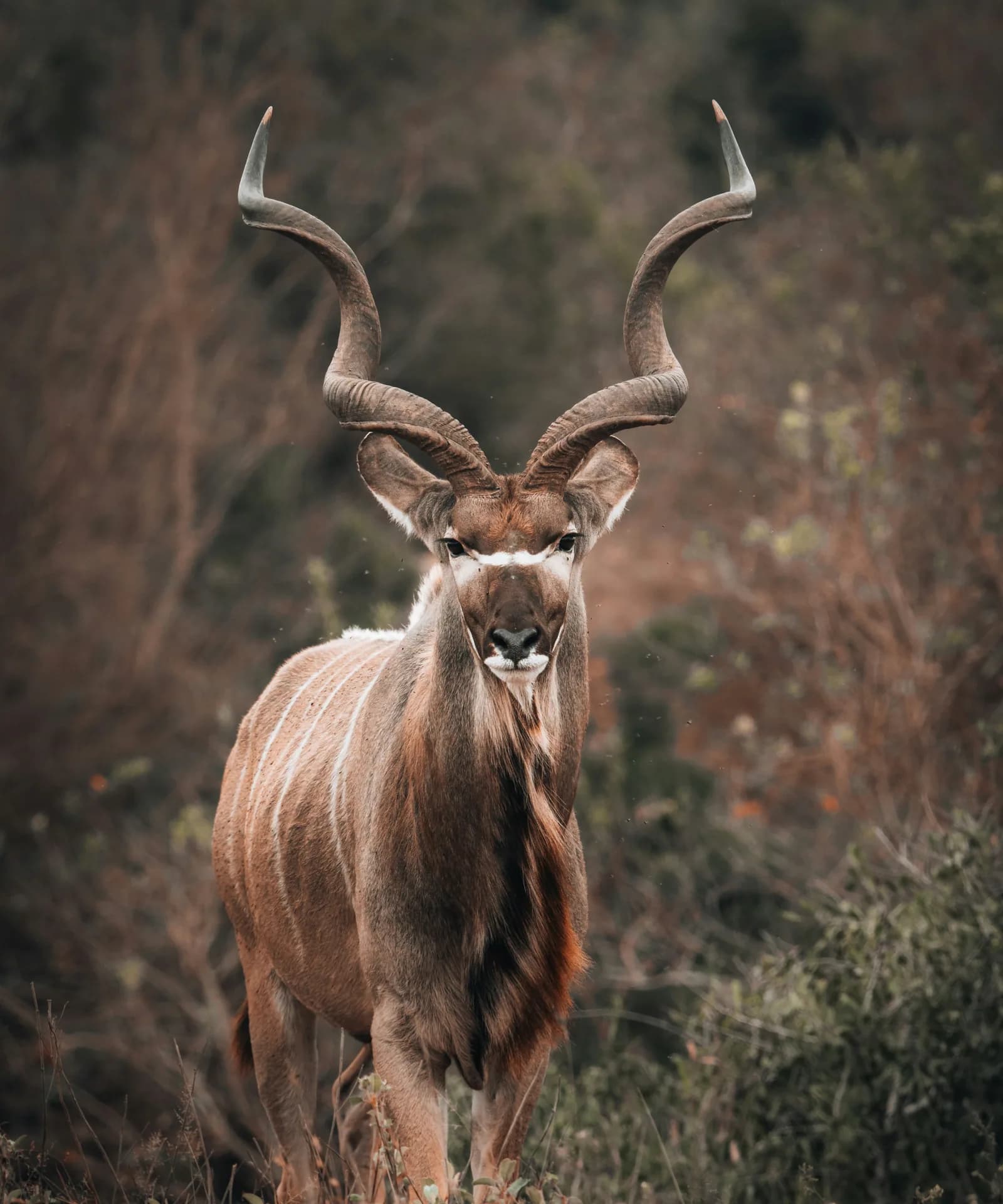
Sable antelope are the benchmark SA plains-game trophy. Mature bulls carry a glossy jet-black coat against a white belly and face mask, with long scimitar-curved horns sweeping back over the shoulders — a silhouette that no other SA animal matches. The species is the aspirational hunt for many first-time SA clients and the priced accordingly: a mature bull is typically the most expensive plains-game trophy fee on a property's price list, often 3–5× the cost of a kudu.
Two practical points define every sable hunt. First, the margin for error is smaller than the price tag suggests. A wounded sable can genuinely be lost — not "tracked for four hours and recovered" lost, but "never found and the client pays the wounded-animal fee" lost. Properties that carry sable have seen this happen. The combination of thick bush, long-distance retreat after a hit, and the species' legendary toughness means first-shot placement carries more weight than on almost any other plains-game species. The hunter who has been sloppy with placement on impala or blesbok must not be sloppy on a sable.
Second, wounded sable are dangerous and will turn on pursuers. Bulls lower the head, sweep the horns in a wide arc, and charge — the curved horns are long enough to reach the ground and long enough to hook a man at any angle. Cows defending calves will do the same. Tracker injury from wounded sable is documented across the SA hunting industry, and the approach protocol on any down-but-not-confirmed-dead sable is to stand off at 30–40 m and put in a second round from a safe angle before closing.
Calibre is .30 class minimum with a premium bonded bullet. The ethical floor is .300 Winchester Magnum with a 180-grain bonded bullet or .30-06 with a 180-grain bonded. Some PHs prefer .375 H&H on sable for the additional margin — not strictly necessary on a 250 kg animal, but the trophy-fee stakes mean most clients willingly uprate. Cup-and-core bullets have no place on sable.
Distribution in SA is narrow and largely private-land. The core natural range is the northern Limpopo bushveld; most hunt-able populations are on managed game ranches across Limpopo, Mpumalanga Lowveld, and parts of KZN. Public-land populations exist in Kruger but at limited density. The species is expanding on SA private land as re-introduction programmes continue, but sable is nowhere "common" — every hunt is on a managed herd and every bull represents significant investment on the property's part.
Identification
Identifying sable antelope
Sable bulls are unmistakeable at any distance once the curve of the horns catches the light. Cow-calf-bachelor bull identification is the real ID work on a sable hunt.
Both sexes share:
- White belly running from between the front legs back to the inguinal area
- White face mask — white around the muzzle, across the nose, and between the eyes, separated by black stripes from forehead to muzzle
- Long swept-back horns with heavy basal ridging
- Long horse-like neck with an upright black mane from poll to withers
- Erect ears with black tips
- Dark tail with a black tuft
Bulls:
- Coat colour is the primary ID — mature bulls turn glossy jet-black over the shoulders, flanks, and upper body (cows and young bulls remain brown to reddish-brown)
- Horn mass and length — mature bulls' horns carry thick ridged bases (15+ cm basal circumference), deep scimitar curve, and 85–115 cm along-the-curve length
- Heavier neck and shoulder musculature than cows
- Body mass 230–270 kg
Cows:
- Chestnut-brown coat with white belly and face mask — never turn black
- Thinner horn bases, similar spread to bulls but lighter overall
- Lighter body mass (200–230 kg)
- Travel in cow-calf herds
Aging bulls:
- Young (1–3): body still chestnut-brown; horns short (under 60 cm) and thin-based
- Sub-adult (3–5): coat darkening to very dark brown; horns 60–80 cm; basal ridging developing
- Prime (6–10): coat glossy black; horns 85–105 cm with heavy ridged bases
- Old (10+): coat black, may show some fading or scars; horns at peak length 95–115 cm with maximum basal mass; often broomed tips
Common misidentifications:
- Roan antelope — same genus (Hippotragus), similar body structure. Distinguishing marks: roan is much larger (270–300 kg bulls), sandy grey-brown coat (never glossy black), shorter horns (60–85 cm), and a distinctive white face mask with black "clown-face" pattern unlike sable's simpler mask
- Young sable bulls vs cows — both are brown. Horn base thickness and scrotal check at close range are the only reliable marks
- Sub-adult vs prime bull — colour alone is unreliable until 5–6 years. Horn mass and basal ridging are the trophy-quality markers
Habitat
Where they’re found
Sable antelope are bushveld specialists with specific habitat requirements that make their distribution naturally patchy even within core range.
South African distribution:
- Limpopo — northern Waterberg, northern bushveld properties, parts of the Lowveld. Core SA range
- Mpumalanga Lowveld — Kruger and surrounding private properties; strong public-land presence
- KwaZulu-Natal — northern bushveld properties; introduced populations
- North West — bushveld properties; re-introduced populations on managed game ranches
- Eastern Cape — introduced on some game properties; not historically core range
- Free State, Northern Cape, Gauteng, Western Cape — not core range; limited private-land introductions only
Most SA trophy hunts happen on managed game ranches in Limpopo and Mpumalanga where the property actively maintains sable-suitable habitat.
Habitat preferences within range:
- Savanna woodland with tall grass — the classic sable habitat. Broadleaf woodland (miombo, mopane-adjacent, silver-leaf terminalia) with a tall-grass understory is prime
- Open vleis and pan edges — used for feeding in the early morning and late afternoon, especially in dry season
- Mid-elevation bushveld — sable avoid both thick riverine forest and very open grassland
- Avoided: fynbos, montane grassland, true savanna without overhead cover, Karoo scrub
Water dependence is moderate to high — sable need daily water in dry season but can draw moisture from succulent grasses during the rains. They don't range as far from water as gemsbok or springbok; 3–4 km from water is a typical upper limit.
Sable are selective grazers preferring mid-height perennial grasses. This makes them sensitive to habitat degradation — overgrazed paddocks support sable poorly even if cover and water are present. Properties that carry healthy sable populations actively manage grass-sward quality.
Altitude range in SA is 400–1,400 m. Sable don't occur at high elevation.
Behavior
Behavior & herd structure
Sable social structure centres on nursery herds and dominant bulls. Cow-calf herds of 10–30 animals occupy home ranges that overlap with dominant-bull territories. Bachelor groups of young bulls form loose aggregations at the periphery. Mature bulls defend specific territories year-round, not just during rut.
Activity pattern: diurnal with a pronounced mid-morning rest period. Feeding peaks are early morning (first two hours of daylight) and late afternoon (last three hours before dusk). Midday is spent bedded in shade, typically in closed-canopy woodland. This bimodal pattern is sharper on sable than on most plains-game species — a sable herd at noon in open country is uncommon.
Rut: sable breed year-round but calving is concentrated in the wet season (January–March in most SA range), meaning rut-peak pressure on dominant bulls is August–October. Territorial bulls during this period are more predictable (fixed territory, patrolling behaviour) but also more aggressive.
Behavioural traits for the hunter:
- Alarm snort and tail-flick. Sable alarm with a sharp blowing snort and raised-tail posture before committing to flight. The snort is often the first audible cue on a stalk
- Head-on standing display. A mature bull confronted at close range may present head-on with horns tilted forward — this is a threat display, and on a wounded bull it's a charge precursor. Recognise and act accordingly
- Long flight distance. On alarm, sable typically run 300–600 m before stopping to re-assess. Much further than a kudu or nyala. First-shot opportunity is usually the only opportunity
- Herd cohesion. Nursery herds bunch tightly under alarm — target separation becomes critical. A bunched 20-animal herd at 120 m presents no ethical single-animal shot. Wait
- Bull-at-the-flank. The dominant bull almost never leads the nursery herd in movement; he flanks or trails, watching. Mare-led movement means the lead animal is the wrong target
- Wallowing sites. Sable wallow in mud at specific sites, typically near pans. A fresh wallow tells you the herd used the site within hours — useful for pattern work
Hunting
Hunting sable antelope
Common errors:
- First shot too rushed. The trophy-fee stakes tempt hunters to take marginal shots "while they have the chance". A marginal shot on a sable is the start of a hard tracking job and possibly a lost animal. Rule: if it's not a confident shot on a bonded .30-class rifle, don't pull the trigger. Wait for better
- Under-calibre. Sable are tougher than their 250 kg mass suggests — heavy bone, thick hide, famously absorbent of lead. A .270 with a standard bullet is under-gunning. The ethical floor is .30 class with a premium bonded bullet; .300 Win Mag / 7mm Rem Mag / .375 H&H are routine and welcome
- Approaching a down sable from behind or too close. Wounded sable will charge; horns reach the ground and can hook a man. Protocol: stand off at 30–40 m, watch for ear movement and abdominal breathing, put a second round into a suspect animal before closing
- Mistaking a sub-adult bull for a trophy bull. Sub-adult bulls carry 70–80 cm horns with moderate ridging and a dark-brown (not black) coat. Mature trophy bulls are 85+ cm with heavy ridging and glossy black coat. Paying a trophy fee for a sub-adult is a common and expensive mistake. Trust the PH's call on age class
- Shooting at a bunched herd. Sable nursery herds bunch tight under alarm. Bullets pass through one animal into the next. Wait for target separation
- Shooting the lead animal. Dominant bulls flank or trail; they don't lead. The lead animal of a moving herd is almost always a cow or young animal
Distances. Typical shot is 80–200 m. Most SA sable hunts happen in broadleaf bushveld where cover pulls shots in; 50–120 m is common. Open-vlei shots can stretch to 250 m on some properties. 300 m+ is a stretch given cover patterns and the premium on certain first-shot placement.
Rifle setup. Floor is .30-06 with a 180-grain premium bonded bullet. Sweet spot is .300 Winchester Magnum / 7mm Remington Magnum with 180–200 grain bonded bullets. Many PHs prefer .375 H&H with solid-base softs on sable — genuinely overkill on animal size, but the trophy-fee stakes justify the margin. Cup-and-core bullets are a poor choice at any calibre.
Zero 100 m with known drops to 300 m. Most sable shots are taken from sticks in standing or sitting position; practise both. A confident offhand shot past 150 m is rarely available and rarely necessary.
What to expect from your PH. Sable hunts are typically multi-day, patient stalking affairs. Expect: early starts to catch the morning feeding window, detailed glassing of specific herds the PH knows by sight, slow approaches designed to put you in a position where a confident first shot is available. The PH will age and measure bulls before green-lighting a shot — trust that process. On properties with multiple bulls, the decision on which bull to take can be a half-day affair involving comparing horn length, basal mass, and coat condition on two or three candidates.
Recovery on a well-hit sable is usually within 50–150 m. Recovery on a poorly-hit sable is a hard, potentially dangerous tracking job that may involve dogs. The property will have recovery protocols — follow them.
Conservation
Conservation status
Sable antelope are listed as Least Concern on the IUCN Red List across the species range. Southern sable specifically — the SA subspecies — is stable and expanding on SA private land through managed game-ranch populations.
Wild free-ranging populations in SA are largely restricted to Kruger National Park and a handful of public reserves. The bulk of the SA population — and essentially all hunt-able sable — is on private game ranches in Limpopo, Mpumalanga, KZN, and selected properties elsewhere. Re-introduction programmes since the 1980s have expanded the species' SA range significantly, though sable remains among the more valuable and actively-managed species on any property's price list.
The hunting industry's relationship with sable is essentially a breeding-and-stewardship economics story. Trophy fees on sable bulls (typically R60,000–R150,000+ at current SA pricing) make the species financially worthwhile to breed and protect even where natural density is low. Properties invest in sable-suitable habitat (grass management, water points, boundary fencing) specifically to hold viable herds. Without that economic incentive, SA's sable population would be significantly smaller than it currently is.
Colour morph note: giant sable (Hippotragus niger variani) is a separate, critically endangered subspecies endemic to Angola. It is not the same animal as the SA southern sable, is not hunt-able anywhere, and should never be confused with the southern sable trophy. SA hunting operators selling "giant sable" trophies are either mis-labelling southern sable or engaged in something illegitimate — ask carefully if the term comes up.
Hybrid note: sable and roan are the same genus and can interbreed under managed-breeding conditions, though this is rare. Hybrids are not scored by any record-book and are an ethical grey zone. Responsible properties do not mix breeding groups.
Shot placement
Where to place the shot
Always know your target anatomy before pulling the trigger. These are reference landmarks for ethical, humane kills. Conditions, distance, and animal posture change everything.
Broadside
Heart-lungLandmark: Vertical line up from the back of the front leg, one-third up from the brisket. Slightly forward of the leg-line for a heart-anchor hit.
The primary sable shot. A .30-class bonded bullet through this landmark anchors or produces a short recovery. Middle-of-body hold is too high.
Calibre floor
.30 class with bonded bulletQuartering-away
Heart-lungLandmark: Aim at the far-side shoulder joint. Entry through the near ribs behind the near shoulder.
Workable at moderate angles (up to ~30° quartering) with a premium bonded bullet. Steeper angles push the path through too much muscle and risk an under-penetrating hit.
Calibre floor
.30 class with bonded bulletQuartering-toward
Heart-lungLandmark: Near-side shoulder joint, on the leg line. Angles through the near lung into the off-side chest.
Tight margin. Sable shoulder bone is heavy and the hide thick — marginal quartering-toward shots are the classic lost-sable scenario. Pass in crosswind or at range.
Calibre floor
.300 Win Mag / 7mm Rem Mag with bonded bulletFrontal
Heart-lungLandmark: Centre of the chest at the sternum notch where neck meets brisket.
Available on a stopped head-up bull. Requires bonded bullet in .30 class minimum and a calm, confident hold. Not a shot past 150 m on a sable given the target-fee stakes.
Calibre floor
.30 class with bonded bulletGoing-away
No ethical shotLandmark: No landmark. A going-away sable presents only rump and gut. Wounded sable recovery is hard enough on a good shot placement — don't compound it with a guaranteed marginal one.
Don't take going-away shots on sable. The cost of a wounded-and-lost sable is among the highest in plains-game hunting. Wait for the herd to turn.
High-shoulder anchor
High-shoulderLandmark: Top of the shoulder blade, one-quarter down from the spine line.
Useful on a bull about to break into thick bush where recovery would be dangerous. Breaks the spine and anchors in place. Destroys shoulder cape — acceptable if the alternative is a long wounded-animal track.
Calibre floor
.30 class with bonded bullet
Available at
Farms offering sable antelope
No farms currently offering this species on SkietNet.