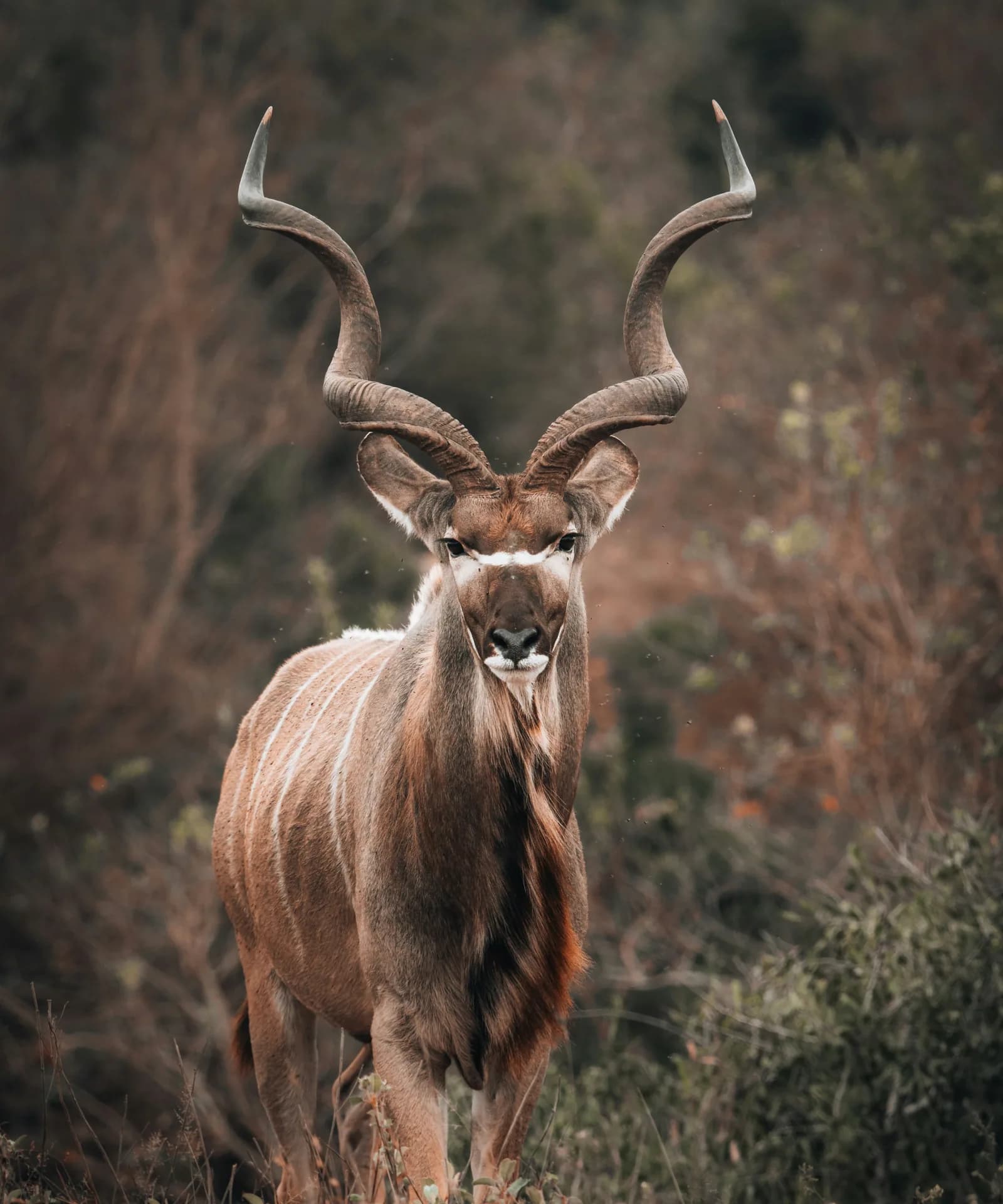

Plains game
Roan Antelope
Bastergemsbok · Hippotragus equinus
Scarce, expensive, and tougher than its size — roan hunts demand premium calibre, patient stalking, and the same first-shot discipline as sable.
Overview
About the species
Roan antelope are the largest SA antelope after eland — mature bulls run 270–300 kg on a long-legged, horse-like frame that carries the common Afrikaans name bastergemsbok ("mongrel gemsbok") and the English sub-label "horse antelope". They're scarce across most of SA: natural populations exist only in limited pockets of Limpopo and Mpumalanga, and the bulk of hunt-able roan in SA are on managed game-ranch populations that re-introduced the species over the past 30 years.
The defining visual features are the distinctive black-and-white "clown-face" mask — black from the eyes to the muzzle with white around the eyes, forehead, and lower jaw — and the sandy grey-brown to reddish-brown coat with a darker mane running from poll to withers. Horns sweep back in a moderate scimitar curve, shorter and heavier than sable horns, with significant basal ridging on mature bulls.
Two practical points define every roan hunt. First, roan are harder to anchor than their 280 kg mass suggests. Like sable and eland, they carry heavy bone, thick hide, and a famous capacity for absorbing lead. A marginal first shot starts a long tracking job, and on managed-population properties where replacement animals cost heavily, a lost roan is an expensive event. Calibre floor is .30 class bonded; .300 Winchester Magnum or .375 H&H are routinely preferred.
Second, wounded roan will charge. The same genus as sable (Hippotragus), they carry the same defensive behaviour — horns swept forward in a wide arc, head lowered, committed charge at close range. Tracker injury from wounded roan is documented. The approach protocol matches sable: stand off at 30–40 m, confirm death before closing, second-round insurance on any suspect animal.
Distribution in SA is narrow. Core natural range is the northern Limpopo bushveld and parts of the Lowveld. Most hunts happen on Limpopo or Mpumalanga game ranches that maintain managed herds. The trophy fee is among the highest on SA price lists, typically matching or exceeding sable.
Identification
Identifying roan antelope
Roan bulls are distinguishable from other large SA antelope once the face mask and body size register. The ID work on a roan hunt is primarily bull-vs-cow and age class.
Both sexes share:
- Sandy grey-brown to reddish-brown coat — never the glossy black of mature sable
- Distinctive "clown-face" mask — black from eyes to muzzle with white around eyes, forehead, and lower jaw. The sharpest facial marking of any SA antelope
- Long pointed ears with dark tips and a lighter interior — longer than sable's ears
- Upright dark mane from poll to shoulder, sometimes extending to withers
- Shorter and heavier swept-back horns compared with sable
- Dark tail with a long black tuft
- Long, horse-like neck and legs
Bulls:
- Heavy body mass (270–300 kg) and heavier shoulder musculature than cows
- Thicker horn bases with pronounced ridging on mature animals
- Slightly darker coat, especially along the spine and rump
- Obvious male genitalia at close range
Cows:
- Lighter body mass (230–270 kg)
- Thinner horn bases with less ridge development, though horn length can match bulls
- Lead nursery herds; bulls flank or trail
Aging bulls:
- Young (1–3): coat pale, horns short (under 50 cm), face mask present but softer
- Sub-adult (3–5): coat darkening, horns 50–65 cm, ridging developing
- Prime (6–10): coat fully developed, horns 65–80 cm with heavy ridged bases
- Old (10+): coat may fade slightly; horns 75–85 cm with maximum basal mass; tips often broomed
Common misidentifications:
- Sable antelope — same genus. Distinguishing marks at distance: sable is smaller (230–270 kg vs 270–300 kg), darker overall (mature bulls glossy black), simpler face mask, and longer more dramatically curved horns. Roan has the clown-face and the shorter heavier horns
- Gemsbok — similar size class but gemsbok has long straight spear-horns (not curved), black body-stripes, and a more compact build. The Afrikaans bastergemsbok name refers to roan looking "like a gemsbok but wrong"
- Young roan bulls vs cows — colour and size are similar. Horn base thickness and scrotal check at close range are the only reliable marks
Habitat
Where they’re found
Roan antelope prefer tall open-to-semi-open savanna with a good grass component. Distribution in SA is narrower than most plains-game species because suitable habitat is less widespread.
South African distribution:
- Limpopo — northern Waterberg, Soutpansberg fringe, parts of the Lowveld. Core natural range
- Mpumalanga Lowveld — Kruger and some surrounding private properties; limited natural populations
- KwaZulu-Natal — introduced populations on selected game ranches; not historically core
- North West — introduced populations on managed properties
- Free State, Northern Cape, Eastern Cape, Western Cape, Gauteng — not core range; limited private-land introductions only
Most SA roan hunts happen on managed Limpopo or Mpumalanga game ranches that carry resident breeding herds. Free-ranging roan populations in SA are small.
Habitat preferences within range:
- Tall open savanna with a good perennial grass component — the classic roan habitat. More open than sable's preferred broadleaf woodland
- Open vleis and pan edges — used for feeding, especially in dry season
- Mid-height woodland with scattered trees — acceptable where grass cover is good
- Avoided: thick bushveld, riverine forest, true grassland without shade, rocky country, Karoo scrub
Water dependence is moderate — roan need daily drinking water in dry season. They range 3–5 km from water in most conditions, slightly further than sable. Heat tolerance is moderate; they rest in light shade during midday heat.
Roan are selective grazers that prefer mid-height perennial grasses in good condition. They're sensitive to overgrazing and habitat degradation — properties that have successfully re-introduced roan actively manage grass-sward quality and stocking densities. This selectivity partly explains why roan are less widespread than equally-large gemsbok, which can use drier and more degraded habitat.
Altitude range in SA is 400–1,500 m. Roan don't occur at high elevation.
Behavior
Behavior & herd structure
Roan social structure centres on small nursery herds of 5–15 animals led by a dominant cow, with a single territorial bull associated with each herd year-round. Bachelor bulls form loose aggregations at the periphery of good habitat. Nursery herds are smaller than sable nursery herds — a group of 20+ roan is unusual.
Activity pattern: diurnal with a pronounced mid-morning rest period. Feeding peaks early morning (first 2 hours of daylight) and late afternoon (last 2–3 hours before dusk). Midday is spent bedded in light shade, typically on slightly higher ground with good visibility. A roan herd resting at noon usually chooses a spot with 100+ m of sight line — they prefer to see approaching threats from distance.
Rut: roan breed year-round with calving concentrated in the wet season. Territorial bull pressure is moderately constant rather than sharply seasonal, so "rut season" isn't a strong hunting-planning factor on roan the way it is on some species.
Behavioural traits for the hunter:
- Visual alertness. Roan have excellent eyesight and prefer habitat with long sight lines. They detect approaching hunters at distances where most plains-game wouldn't notice. Stalk discipline matters more than on bushveld species
- Alarm snort and stamp. Roan alarm with a sharp nasal snort and a forefoot stamp before committing to flight. Often two or three snorts in sequence before the herd moves
- Standing-watch posture. A roan herd under suspicion but not yet committed to flight will stand in a line facing the threat, ears forward. This is the opportunity window — 20–60 seconds typically — before they run. A competent shot during this period is often the only shot available
- Long flight distance. On committed alarm, roan run 500 m–1 km before stopping to re-assess. First-shot opportunity is almost always the only opportunity. A missed shot rarely produces a second chance on the same animal
- Bull-at-the-flank. The dominant bull patrols the flank or trails the herd; he doesn't lead. Mare-led movement means the lead animal is not the target
- Calf defence. Cows with calves interpose themselves aggressively. Don't push approach distance when calves are present — the herd will break before you're in range
Hunting
Hunting roan antelope
Common errors:
- First shot too rushed. Roan trophy fees are high; wounded-and-lost outcomes are expensive. The discipline is the same as on sable: if it's not a confident shot on a premium bonded rifle, don't pull the trigger. Wait for better. A roan herd that detected you will likely not offer a second chance, and that's fine — a passed hunt beats a lost animal
- Under-calibre. Roan are the second-largest SA antelope after eland. A .270 with a standard bullet is under-gunning; even a .30-06 with cup-and-core construction is marginal. Ethical floor is .30 class with a premium bonded bullet; .300 Win Mag / 7mm Rem Mag / .375 H&H are routine
- Approaching a down roan from behind or close. Wounded roan will charge — same defensive behaviour as sable, same lethal horn arc. Stand off at 30–40 m, watch for signs of life, put in a second round before closing. This is not optional
- Under-aging the bull. Sub-adult bulls (3–5 years) carry 60–70 cm horns with moderate ridging. Prime trophy bulls are 70–85 cm with heavy ridged bases. Paying a trophy fee for a sub-adult is a common mistake on fast-moving herds. Trust the PH's age call
- Shooting at a bunched herd. Roan nursery herds bunch tight under alarm. Bullets pass through one animal into the next. Wait for target separation
- Shooting the lead animal. Dominant bulls flank or trail; cows lead movement. The lead animal of a moving herd is almost always a cow
Distances. Typical shot is 100–200 m. Roan's preferred open savanna habitat stretches shots to 250 m regularly and 300 m on some properties. Cover-pulled shots under 100 m are less common on roan than on sable.
Rifle setup. Floor is .30-06 with a 180-grain premium bonded bullet. Sweet spot is .300 Winchester Magnum with 180–200 grain bonded bullets. .375 H&H with 270–300 grain solid-base softs is a routine choice on roan — the additional margin is welcome on a 280 kg animal at distance, and most PHs actively prefer it. Cup-and-core bullets have no place on roan at any calibre.
Zero 100 m with known drops to 300 m. Most shots are taken from sticks in standing or sitting position. Roan hunts usually allow more shot preparation time than wildebeest or zebra hunts because the herd's standing-watch posture provides a window — take it.
What to expect from your PH. Roan hunts are patient, often multi-day affairs. Expect: early starts to catch morning feeding, extensive glassing of known herds, slow approaches that use terrain folds and wind discipline, off-sticks shots at 150–250 m during the standing-watch window. The PH will age and measure bulls carefully before green-lighting — roan are scarce enough that trophy-quality calls matter more than on common species. On properties with multiple bulls, comparing candidates across two or three days is normal.
Recovery on a well-hit roan is usually within 100–200 m. Recovery on a poorly-hit roan can be a long and potentially dangerous tracking job. Properties will have recovery protocols including dog teams on some hunts — follow them.
Conservation
Conservation status
Roan antelope are listed as Least Concern on the IUCN Red List at the species level, though the species has declined significantly across parts of its range over the past 50 years. Southern African roan populations specifically are small compared with historical levels, and regional declines in Zambia, Tanzania, and parts of the northern SA border have been documented.
In SA the roan story is primarily a private-land conservation case. Wild free-ranging populations in SA are limited to Kruger and a handful of public reserves at low densities. The bulk of the SA population is on managed game ranches in Limpopo and Mpumalanga that re-introduced the species over the past 30 years. Re-introduction programmes have successfully established resident breeding herds on many properties that previously held no roan, expanding SA's roan population well beyond what wild habitat alone would support.
The hunting industry's relationship with roan is a similar story to sable: high trophy fees (typically matching or exceeding sable at R80,000–R180,000+ at current SA pricing) make the species financially viable to breed and hold. Properties invest heavily in habitat quality and fence integrity specifically to maintain roan herds. Without that economic incentive, SA's roan population would be substantially smaller.
Regional concerns persist. Roan populations in some neighbouring SADC range states (Zambia, Mozambique) have declined to concerning levels due to poaching and habitat loss. SA's managed-population approach is one of the more successful conservation models for the species regionally, though it depends on a functioning game-ranch economy continuing to value the species.
Hybrid note: roan and sable are the same genus and can interbreed under managed-breeding conditions. Hybrids are rare, not scored by any record-book, and considered an ethical grey zone by responsible operators. Properties that hold both species keep breeding groups on separate paddocks.
Subspecies note: southern roan (Hippotragus equinus equinus) is the SA subspecies. Other subspecies exist in West, Central, and East Africa; these are not relevant to SA hunts and are generally not hunt-able outside specific licensed range states. SCI and RW scoring is by subspecies category.
Shot placement
Where to place the shot
Always know your target anatomy before pulling the trigger. These are reference landmarks for ethical, humane kills. Conditions, distance, and animal posture change everything.
Broadside
Heart-lungLandmark: Vertical line up from the back of the front leg, one-third up from the brisket. Slightly forward of the leg-line for a heart-anchor hit.
The primary roan shot. A .30-class bonded bullet through this landmark anchors or produces a short recovery. Middle-of-body hold is too high.
Calibre floor
.30 class with bonded bulletQuartering-away
Heart-lungLandmark: Aim at the far-side shoulder joint. Entry through the near ribs behind the near shoulder.
Workable at moderate angles with a premium bonded bullet. The extra body mass on roan compared with sable means even more need for controlled expansion and deep penetration.
Calibre floor
.300 Win Mag / 7mm Rem Mag with bonded bulletQuartering-toward
Heart-lungLandmark: Near-side shoulder joint, on the leg line. Angles through the near lung into the off-side chest.
Tight margin on a roan. The shoulder bone is heavy and the hide thick. Pass in crosswind or at range; wait for broadside.
Calibre floor
.300 Win Mag / 7mm Rem Mag with bonded bulletFrontal
Heart-lungLandmark: Centre of the chest at the sternum notch where neck meets brisket.
Available on a stopped head-up bull during the standing-watch alert posture. Bonded bullet in .30 class minimum. Not a shot past 150 m given the target-fee stakes.
Calibre floor
.30 class with bonded bulletGoing-away
No ethical shotLandmark: No landmark. A going-away roan presents only rump and gut. Wounded roan are dangerous to recover and expensive to lose.
Don't take going-away shots on roan. Wait for the herd to turn — it usually does within minutes on re-alarm when the threat is no longer visible.
High-shoulder anchor
High-shoulderLandmark: Top of the shoulder blade, one-quarter down from the spine line.
Useful on a bull about to break into thick cover where recovery would be dangerous. Breaks the spine and anchors in place. Destroys shoulder cape — acceptable if the alternative is a long wounded-animal track.
Calibre floor
.30 class with bonded bullet
Available at
Farms offering roan antelope
No farms currently offering this species on SkietNet.