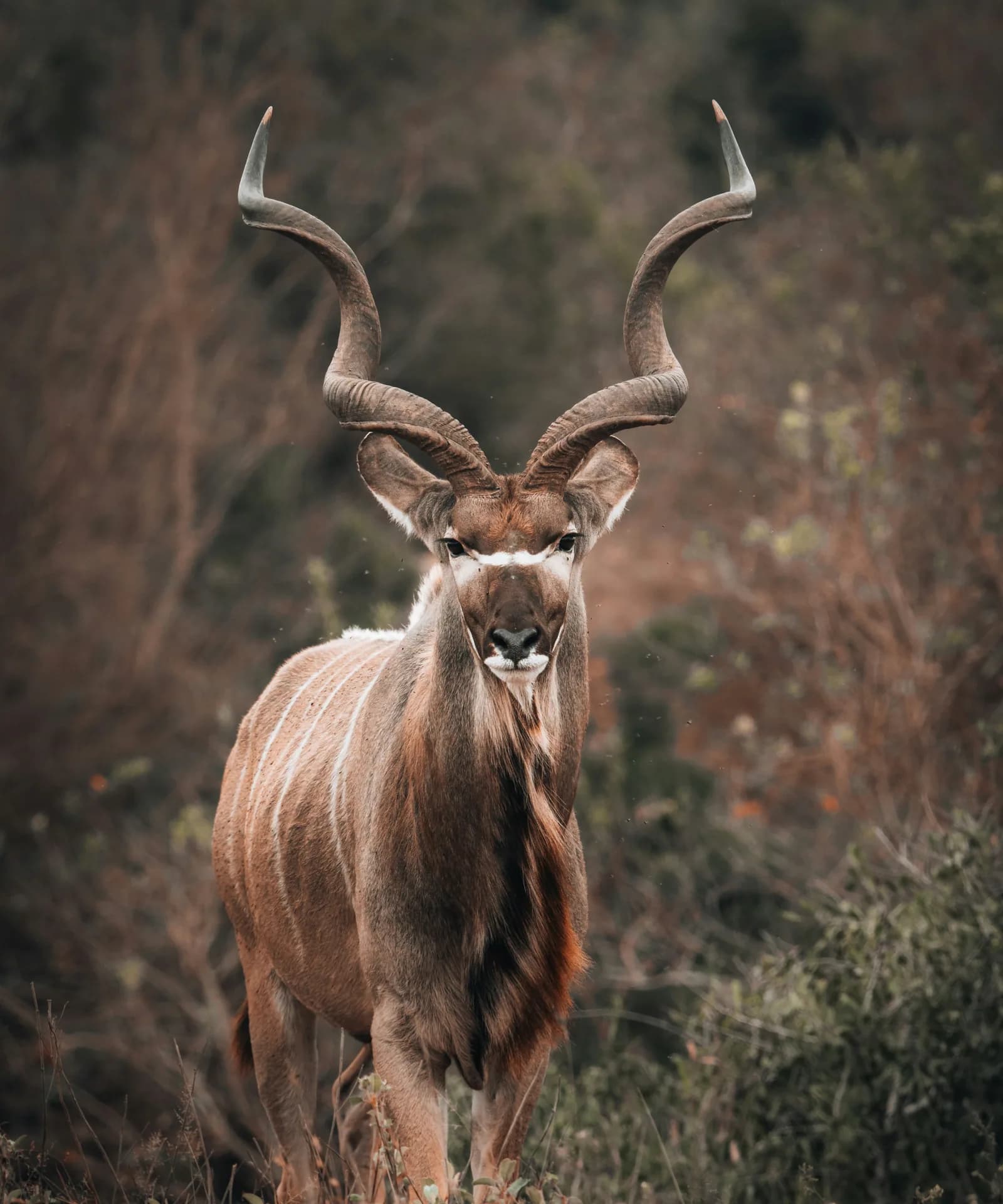

Plains game
Gemsbok
Gemsbok · Oryx gazella
Arid-country specialist with horns on both sexes — and the only plains-game animal with a documented reputation for killing what wounds it.
Overview
About the species
Gemsbok are the plains-game specialist of arid country. Where kudu need bushveld, impala need water, and waterbuck need both, gemsbok are adapted for the Karoo, the Kalahari, and the Northern Cape shrublands — places other antelope thin out or disappear. They’re built for heat and drought: a counter-current blood cooling system in the nasal passages lets them tolerate core body temperatures that would kill most mammals, and they can go weeks without drinking by extracting moisture from tsamma melons and desert shrubs.
The silhouette is unmistakable. Stocky, horse-sized body in silver-grey with black-and-white facial mask, a black stripe along the flanks, and straight or slightly back-swept horns on both sexes. At any practical distance, there is no confusion with other plains game.
Two things make the hunt interesting beyond the calibre question. First, both sexes carry horns of similar overall length, and cows frequently have longer horns than bulls — sex identification is by horn base thickness and body mass, not by horn presence or length. A cow with 125 cm horns looks like a massive bull to an untrained eye; her thin bases and lean forequarters give her away to an experienced PH. Second, the species has a documented history of killing predators that tried to take them, including lions that have ended up impaled on the horns mid-attack. That defensive instinct applies to wounded animals and hunters — a wounded gemsbok on the ground is not to be approached casually.
South African distribution is arid-dominant: the Northern Cape Kalahari, the Karoo, the western edge of the Free State, Northern Bushveld on arid properties, and extensions into the Eastern Cape karoo. They’re not a Lowveld or riverine animal — you won’t find them in the KZN thornveld or the eastern Limpopo wet bushveld except as introduced populations on fenced farms.
Identification
Identifying gemsbok
Gemsbok silhouette is the clearest of any plains-game animal. The challenge is not species ID, it’s sex ID — which matters because trophy scoring favours bulls by a wide margin.
Both sexes share:
- Silver-grey to tan body with distinct black-and-white face mask
- Black lateral stripe along each flank from shoulder to rump
- Black legs (front and rear) with white above the hoof
- Horns: long, ridged at the base, straight or slightly back-swept
- Compact, powerful build with heavy shoulders
Bulls (trophy markers):
- Horn base thickness. A mature bull’s horns are dramatically thicker at the base than a cow’s of similar length. This is the single most reliable sex marker at any distance
- Heavier forequarters and neck. Bulls are more muscular through the chest and shoulders; cows are leaner
- Body mass. A mature bull is 20–30 kg heavier than a cow of similar age — visible on side profile
- Horn length often shorter. Bulls average 85–115 cm; cows commonly run 110–125 cm. Length is not the trophy marker
Cows:
- Thinner horn bases. The giveaway at trophy distance
- Leaner body. Narrower through the shoulders, slimmer neck
- Often longer horns. Thin and tapering rather than thick and ridged
Aging bulls in the field is about horn base development. Young bulls (2–4 years) have thinner bases with minimal ridging; prime bulls (5–8) show the deep basal ridges and full mass; old bulls (8+) often show broomed tips and gnarled bases. Broomed tips are common in populations where bulls fight each other, and they reduce horn length measurement while not affecting the trophy case for an obviously old animal.
The only real field-identification trap is the occasional cow with unusually thick bases — rare but not unknown. When in doubt, watch body posture: bulls carry themselves with a heavier front-end stance, cows appear more evenly balanced. A PH who knows the property will have been tracking resident bulls for months; trust the call.
Habitat
Where they’re found
Gemsbok are arid-country antelope. They flourish where annual rainfall drops below 400 mm and where grass-shrub mosaic dominates over woodland. They use rocky outcrops for shade during the heat of the day and shift to open grassland for morning and evening grazing.
South African distribution:
- Northern Cape — Kalahari sandveld — core SA range. Kgalagadi Transfrontier Park and surrounding private properties carry the highest densities. Trophy quality is strong here
- Karoo (Northern, Western, Eastern Cape) — established on most large karoo game farms. The semi-arid shrubveld is prime habitat
- Free State — western edge — present on arid-country properties bordering the Northern Cape
- North West — western parts — Kalahari-edge properties
- Limpopo — arid pockets — introduced populations on arid-bushveld farms
- Western Cape — inland karoo — strong populations on large properties east of the Cederberg
- Eastern Cape — inland karoo and thornveld — established on most big karoo game farms
They’re absent from the Lowveld, KZN, the eastern Free State grassveld, the southern Cape fynbos, and the wetter parts of the Eastern Cape. Introductions onto wetter bushveld properties exist but the species doesn’t carry density there and the economics usually favour kudu and impala instead.
Habitat preferences within range:
- Arid savanna and open shrubland — primary feeding ground
- Kalahari dune country with tsamma melons — moisture source in dry seasons; herds return predictably to tsamma patches
- Rocky outcrops and kopjes — shade during hot middays
- Avoided: dense woodland, riverine forest, tall grassland that obscures visibility
Water independence is significant. Gemsbok can go a week or more without drinking in cool conditions, extracting moisture from browse and specifically from tsamma melons in the Kalahari. This means they’re less tied to known waterholes than most plains game — you can’t rely on water-blinds for gemsbok the way you can for impala or warthog.
Altitude range is modest: sea level to around 1,500 m. They tolerate heat exceptionally well but cold poorly; the high Highveld interior isn’t their habitat.
Behavior
Behavior & herd structure
Gemsbok herd structure is medium-sized and flexible. Mixed herds of 10–40 animals (cows, calves, and mid-age bulls) are typical. Mature bulls may hold loose territories around productive feeding ground or move between herds; solitary mature bulls are common in arid country where the calorie cost of staying with a herd outweighs the breeding opportunity.
Activity pattern: crepuscular in summer, more diurnal in winter. In the Kalahari and Karoo, summer temperatures push gemsbok to strict dawn and dusk feeding with middays spent in shade. Winter sees them grazing through much of the day. Night activity is substantial; they browse and walk significant distances in cool hours.
Rut: loose, year-round breeding possible, with peaks in September–November in South African populations. Bulls don’t hold tight territories the way waterbuck do; dominance is established through the horn-clashing contests that give the species its dangerous reputation.
Behavioural traits for the hunter:
- Defensive horn use. Documented cases of gemsbok killing attacking lions by impaling them on the horns. This defensive instinct extends to wounded animals: a gemsbok down on its side will still swing its horns hard if you get within reach. Never approach a wounded gemsbok from ground level. Wait for clear signs of death (no ear movement, no eye response) before closing
- Herd flexibility. Herds break up and re-form frequently. A bull you spotted yesterday with a herd may be alone today and with a different herd tomorrow
- Long-distance escape. Spooked gemsbok run hard and far. Unlike kudu or impala they don’t circle back to the same area — a wrecked hunt is a wrecked property for the rest of that session
- Heat tolerance trap. You’ll see gemsbok feeding in midday sun when everything else is bedded. This isn’t an easy midday hunt opportunity — they see you from farther in the open terrain, and the heat haze at ground level ruins glass and rifle both
- Water independence. Forget water blinds. Gemsbok can and do go long stretches without drinking
Hunting
Hunting gemsbok
Gemsbok hunting is open-country rifle work. Spot-and-stalk dominates; blinds produce less reliably than on bushveld species. The terrain is the primary challenge after the shot — Kalahari dune country and Karoo kopje country both present long walks and heat-management problems on top of the animal itself.
Distances. Typical shot is 150–300 m. Open country and long lines of sight push most shots past the comfort zone most visiting hunters are used to. A 350 m shot on a calm stopped bull is normal; under 150 m is a bonus.
Rifle setup. Gemsbok are tough out of proportion to their weight class. At 200–240 kg they’re lighter than waterbuck but the shoulder muscle and rib structure absorbs bullets better than most similar-weight antelope. Calibre floor:
- Floor: .270 Winchester / 6.5mm class with 140–150 grain premium bonded bullet. Many PHs prefer .30 class
- Preferred: .308 Winchester / 7mm Remington Magnum / .300 Win Mag with 165–180 grain bonded bullet. The extra calibre helps at typical open-country shot distances and reduces wounded-animal recovery issues
- Non-negotiable: premium controlled-expansion bullet. Cup-and-cores can fail on the shoulder bone
- Long-range setup: if you’re going to be taking 300 m+ shots in the open Kalahari, bring a rifle you have true long-range dope for. A 200 m zero without ballistic drops worked out will hit low at 350 m
What to expect from your PH. Gemsbok hunts involve more driving and glassing than most plains-game hunts. You’ll cover terrain between observation points looking for feeding herds, glass carefully for sex ID (especially horn base thickness), then plan a long approach that uses dune troughs, kopje shadow, or shrub mosaic. Stalks often span 1–2 km of open ground on foot.
Common errors:
- Taking the first broadside without picking the mature bull. On a herd with 20 animals, 3–5 may carry trophy-class horns, but only 1–2 have the basal circumference for a high-scoring trophy. Your PH picks the specific animal; don’t shoot "a gemsbok" — shoot "that gemsbok"
- Aiming for heart-lung low on the chest. Gemsbok chest is deep; the heart sits close to the brisket. A kudu-style one-third-up-from-brisket landmark works, but don’t go higher than that or you miss the heart entirely
- Under-gunning in crosswinds. A .270 with a light bullet at 300 m in a 10 m/s crosswind drifts significantly. The gemsbok doesn’t forgive a shoulder miss. Either close the distance or use enough rifle
- Approaching a downed animal too soon. Cannot be repeated enough. Gemsbok have killed lions. A dying animal on its side can and will drive a horn into you if you’re within reach. Wait for absolute stillness, approach from the rear or the head-uphill side, and the PH goes first with a finishing round chambered
- Over-ranging the shot. 400 m shots in open Kalahari country are doable but rarely ethical on gemsbok because the crosswinds and angle calculations compound. Close the distance or let the animal go
Conservation
Conservation status
Gemsbok are listed as Least Concern on the IUCN Red List. Southern populations are stable to increasing; the species benefits substantially from private-land hunting economics in South Africa and Namibia. No CITES listing for southern oryx.
The conservation story is straightforward. Gemsbok require large arid-country properties to support viable populations — many thousands of hectares — and the economic return from trophy hunting is what keeps those properties in wildlife production rather than in marginal livestock or no production at all. On the Northern Cape Kalahari side, private ranches that convert from sheep to gemsbok-focused game operations consistently maintain healthier vegetation and support a broader biodiversity.
Regulated trophy hunting pulls selectively for older bulls with heavy basal circumferences. Reproduction rates are moderate — single calves annually — which means offtake needs careful management, but in practice SA populations have been expanding for decades under the current hunting regime.
Related species worth noting: the East African fringe-eared oryx (Oryx beisa callotis), the scimitar-horned oryx (Oryx dammah, extinct in the wild and only viable through reintroduction programmes), and the Arabian oryx (Oryx leucoryx, recovered from near-extinction). The South African gemsbok population sits in the most stable corner of the genus. SCI and Rowland Ward score SA gemsbok under a single category; introduced exotic oryx on South African farms (rare but exists) score under the exotic category.
Shot placement
Where to place the shot
Always know your target anatomy before pulling the trigger. These are reference landmarks for ethical, humane kills. Conditions, distance, and animal posture change everything.
Broadside
Heart-lungLandmark: Vertical line up from the back of the front leg, one-third of body depth up from the brisket line. Gemsbok anatomy is closer to kudu than to eland here — standard antelope landmark works.
The textbook shot. Bonded or controlled-expansion bullet essential; the shoulder musculature is dense. A slightly forward hit breaks the shoulder ball and anchors cleanly; slightly high or slightly behind both still lung-hit but less decisive.
Calibre floor
.30 class preferred over .270 for reliable anchoring.Quartering-away
Heart-lungLandmark: Aim at the far-side shoulder joint. Entry through the near ribs well behind the near shoulder.
Common open-country presentation when a bull walks across a feeding line. Angle carries the bullet through both lungs and into the off-side shoulder — break the shoulder for the anchor. Premium bullet required.
Quartering-toward
Heart-lungLandmark: Near-side shoulder joint. Angles through the near lung to the off-side rib cage.
Tighter margin than quartering-away, especially at gemsbok-typical 200 m+ distance where wind drift compounds. Pass on this shot past 200 m and wait for broadside.
Frontal
Heart-lungLandmark: Centre of the chest where the neck meets the brisket. Through the sternum into the heart.
Viable on a stopped bull inside 150 m. The brisket plate is heavy; use a mono or heavy bonded bullet in .30 class. Not a shot at extended distance.
Calibre floor
.30 class minimum for reliable chest penetration.Going-away
No ethical shotLandmark: No landmark. A gemsbok going away in open country presents only rump and gut and will cover significant distance before stopping.
Never take a going-away shot on gemsbok. Wounded animals run hard and far in open terrain, the recovery is difficult, and the defensive horn capability means a cornered wounded animal is dangerous to approach. Wait for a better presentation.
High-shoulder anchor
High-shoulderLandmark: Top of the shoulder blade, one-quarter down from the spine line. Breaks upper vertebrae and both upper lung lobes.
Useful when the recovery terrain is bad (deep Kalahari dunes, rocky Karoo kopjes) or on a follow-up to a wounded animal. Anchors in its tracks; destroys shoulder cape. A .30 class or larger with a bonded bullet is required — don’t attempt this shot with a 6.5mm-class round.
Calibre floor
.30 class for reliable spine break.
Available at
Farms offering gemsbok
No farms currently offering this species on SkietNet.