
Plains game
Common Eland
Eland · Tragelaphus oryx
The largest antelope in Africa. Calm, walk-away temperament hides an animal that eats rifle calibre and rewards careful anatomy.
Overview
About the species
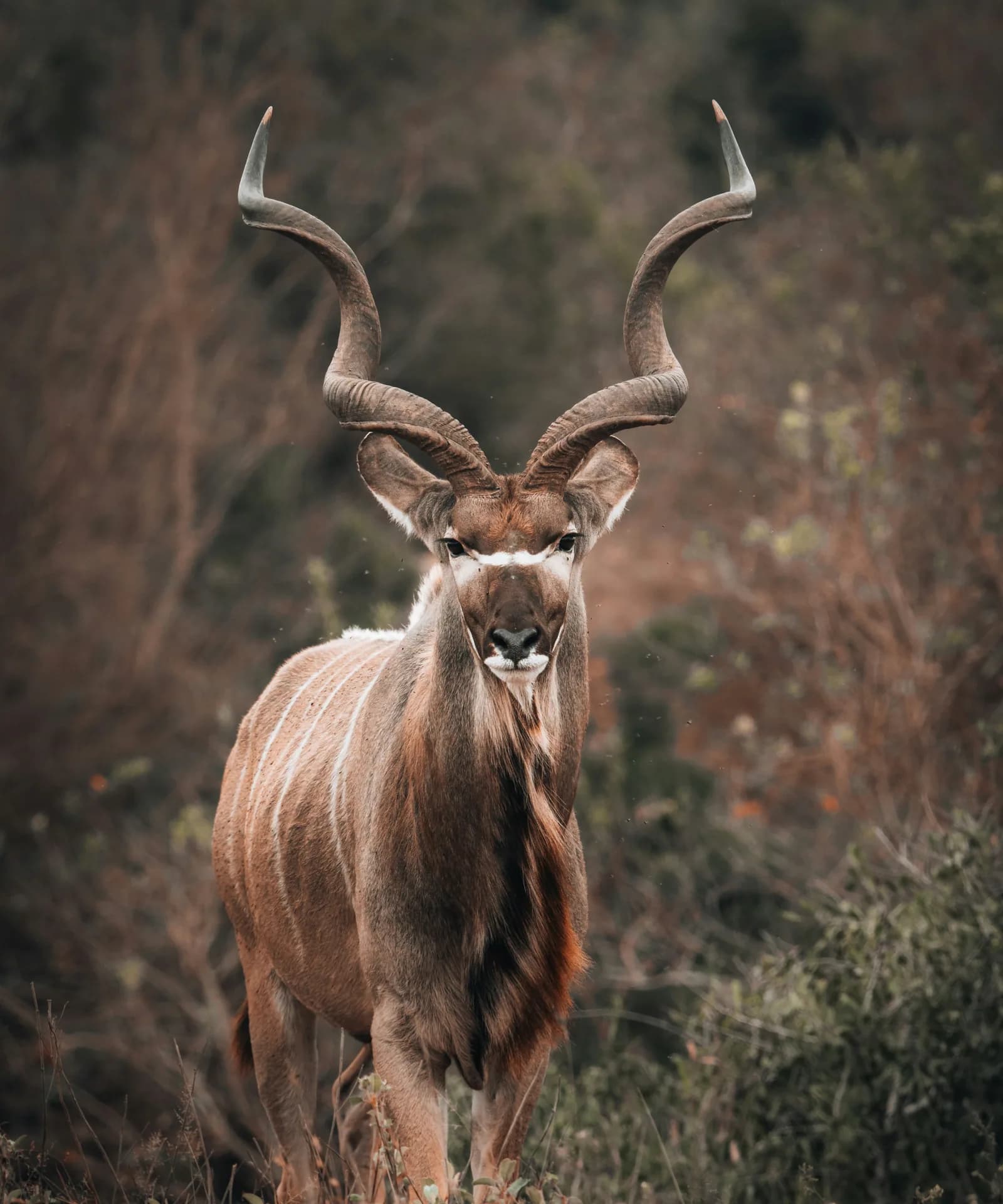
Eland are the largest antelope in Africa by a wide margin. A mature bull runs 700–900 kg and occasionally pushes past a tonne; cows sit at 450–600 kg. Bulls stand 1.5 to 1.8 metres at the shoulder — the same shoulder height as an average horse — and carry the distinctive forehead tuft of coarse black hair, heavy dewlap, and a subtle but permanent corkscrew-spiralled horn that’s thicker-based than any other spiral-horned antelope.
Temperament matters as much as size on the hunt. Eland are famously placid. A disturbed herd often walks rather than runs, and a single bull that has seen you at 200 m will sometimes amble off rather than bolt. Hunters new to the species misread this as an easy animal — they’re not. Eland are tough out of proportion to how calm they look. A marginal hit on a 900 kg bull is a long recovery or a lost animal. The first shot has to be right.
Distribution is wide in South Africa. They tolerate more open country than kudu and handle cold better than most antelope, so they carry through the Highveld and the arid Karoo as well as the bushveld. Private-land re-introductions over the last four decades have expanded the huntable range significantly. Core densities are still northern Limpopo, the eastern Free State, and suitable karoo properties in the Northern and Western Cape.
Both sexes carry horns. Bulls have thick, heavily spiralled bases and shorter-stouter overall horn shape; cows carry longer, thinner, straighter horns. Sex ID is by horn base thickness and body mass, not length — cows frequently out-measure bulls on horn length alone. Trophy scoring favours bulls decisively because of the basal circumferences, so the hunt is specifically for heavy-based bulls.
Identification
Identifying common eland
At any hunting distance, eland are unmistakable. Nothing else in African plains-game country has the same combination of body mass, cattle-like silhouette, and corkscrew horns on both sexes.
Bulls (mature, 5+ years):
- Tan to grey-blue body, darkening across the neck and shoulders with age. The oldest bulls go blue-grey over the front quarters
- Heavy, pendulous dewlap from chin to brisket — the single clearest mature-bull marker at distance
- Dense black forehead tuft of coarse hair, roughly apple-sized on old animals; bulls get this through year three and it thickens with age
- Thick, heavily ridged, short-spiralled horns. Bull horn length is modest (70–95 cm is a strong bull) but basal circumferences are massive
- Body mass visibly heavier through the forequarters than cows
Cows:
- Tan-fawn body, lighter than bulls and uniform across the shoulders
- Minimal or no dewlap
- No forehead tuft
- Horns often longer than bulls’ horns but slender and straighter — less spiral, thinner bases
- Leaner silhouette
Aging bulls in the field is dewlap-and-tuft work. A bull under four years will show a small dewlap and a thin or absent tuft; a prime bull (5–8) shows the heavy dewlap and the developed forehead mop; a true old bull (8+) goes blue-grey and the horn tips often broom.
Eland rarely misidentify in the field — body mass and forehead tuft settle it quickly. The one identification trap is young bulls vs cows at 300 m+, where horn length favours cows and body mass isn’t yet distinctive. Wait for the dewlap outline or the forehead tuft to show before committing. Eland fall easily into a mature-herd stalk because the herds are large and calm, but the "bull" in the middle of a cow herd can be a thick-necked older cow — aging matters.
Habitat
Where they’re found
Eland are generalists by African antelope standards. They handle more varied habitat than kudu, impala, or waterbuck: woodland, savanna, Highveld grassland, Karoo semi-desert, even into mountain grassveld up to 2,200 m. They drink daily where water is available but can go a week or more on moisture from browse in cool conditions.
South African distribution:
- Limpopo bushveld — established populations on most Waterberg and Bushveld properties; core of the private-land trophy quality
- Eastern Free State and KZN midlands grassveld — wild populations expanding; the Drakensberg foothill farms hold reliable numbers
- Karoo, both Eastern and Northern Cape — excellent eland country; their cold and drought tolerance makes them viable on open arid properties where kudu struggle
- North West, Mpumalanga, western Eastern Cape — present on most large game farms
- Western Cape — east of the fynbos, properties in the Cederberg foothills and karoo fringes carry them
Habitat preferences within range:
- Open savanna and mixed woodland — prime feeding ground. Browse on shrubs and trees is the bulk of the diet
- Karoo shrub and open grassland — classic arid-adapted habitat. Herds range widely in arid conditions
- Mountain slopes up to 2,200 m — they move upslope in cool weather, down to valleys in cold
They avoid dense riverine forest (not enough manoeuvring room for the body mass), deep sand areas where walking burns excessive energy, and any habitat that lacks browse diversity. Water is used but not limiting — eland are some of the best-adapted large antelope for arid conditions.
Altitude range is broad, from sea level in the Karoo to around 2,200 m in the Drakensberg foothills. They tolerate frost and snow for short periods but don’t range into the high alpine zones.
Behavior
Behavior & herd structure
Herd structure is looser than most plains game. Eland herds can be very large — 50 to 200 animals on productive properties — and they shift composition continuously. Bulls of all ages mix with cow-calf herds outside the rut; bachelor groups form but don’t persist the way they do in kudu or nyala. A mature trophy bull is often found at the edge or trailing behind a large mixed herd, not inside it.
Activity pattern: partially crepuscular but with strong mid-day activity too. Eland feed through the cooler parts of the day and rest during the heat of midday in summer; in winter they may feed almost continuously. Primary hunting windows remain first light to 09:00 and 15:00 to dark, but the mid-day window is more productive than it is for kudu or nyala.
Rut: more diffuse than most antelope. Peak breeding in South Africa runs January to March. Bulls don’t hold territory in the kudu or waterbuck sense; dominance is established through head-to-head pushing contests and the deepest-voiced, heaviest-bodied bull does most of the breeding.
Behavioural traits for the hunter:
- Calm walk-away. The biggest trait to understand. Eland that have seen you at 200 m will frequently start walking rather than bolting, and the whole herd follows in a loose line. This looks like an opportunity but it’s a closing window — once they’ve moved out of rifle range they won’t stop until they’re done
- Knee-click. Walking eland make an audible tendon click from the forelegs. On calm mornings the sound carries 100+ m and is sometimes your first indication there’s a herd over the next rise
- Dust cloud. Large eland herds kick up enough dust on dry ground to be visible from a kilometre. Check ridges for dust before committing to a closer approach
- Bull wanderer pattern. Old trophy bulls often move alone or in a pair, following the edges of cow herds. They’ll sometimes sit in a thicket near a feeding herd through the middle of the day rather than with them
- Low alarm tolerance once triggered. Once an eland herd is genuinely spooked (not just walking) they travel long distances — often miles — before stopping. Don’t waste a morning pressuring a spooked herd
Hunting
Hunting common eland
Eland hunting is a patience exercise. The usual approach is glass-and-walk: spot a herd from high ground, identify a mature bull (or the trailing solo bull), plan an approach that brings you within 150–200 m with decent cover. Because the herds are large and the animals calm, you can often get closer than you’d expect — the challenge is isolating the target bull from the body of the herd so the shot is clear.
Distances. Typical shot is 120–200 m. Inside 100 m is possible on a calm herd but rare because of body mass constantly in front of the target. Past 250 m is a stretch on an eland because the killing zone is large but misplaced shots are very unforgiving.
Rifle setup. This is the calibre conversation. Take a firm position on it:
- Trophy bulls (700–900 kg): .375 H&H Magnum class is the preferred floor in most SA PH guidelines. A 300-grain controlled-expansion bullet through the vitals drops a mature bull cleanly; smaller calibres risk a long recovery. A .338 Win Mag with a 225–250 grain premium bullet is an acceptable alternative. A .30-06 with a 180–200 grain premium bullet is the absolute ethical floor and many experienced PHs will push back against it on a trophy hunt
- Cows and management bulls (450–600 kg): .308 Winchester / 7mm Remington Magnum with a 180-grain premium bullet is acceptable. .270 Win is marginal and not preferred even on cows
- Non-negotiable: premium bonded or controlled-expansion projectile. Eland ribs, shoulder bone, and the sheer tissue depth demand proper bullet construction. Cup-and-core projectiles are not suitable
What to expect from your PH. Eland hunts play out over longer days than most plains-game hunts. Expect: early start, glass from high ground until a herd is located, long approach (often more than a kilometre on foot), patient waiting for the target bull to separate from the herd, off-sticks shot when the target is clear. The PH’s highest-value calls are the age assessment and the "take that one" moment — because the herd has multiple large animals and picking the right one requires experience.
Common errors:
- Under-gunning the shot. The single most common mistake. A .270 on a trophy bull at 150 m can kill cleanly in perfect conditions; a slightly high or slightly forward hit leaves a wounded 800 kg animal and a long recovery. Use enough rifle
- Antelope-default landmark. Eland chest is dramatically deeper than kudu chest. A hold at "one-third up from the brisket line" on an eland places the shot too low — you clip the heart rim or hit below it. Aim at the mid-body height on the vertical shoulder line, roughly at the level of the elbow joint but not below it
- Shooting the bull in the middle of the herd. Body mass in front and behind of the target bull catches bullets that pass through. Wait for the clear presentation — the bull in the trailing position, or on the edge, is almost always the right one anyway
- Reading "walking away" as an opportunity. A walking eland at 180 m that’s pulling steadily away will be at 350 m in a minute. Take the shot when you have it, or let the animal go and find a different bull
- Not planning recovery. An eland down is 700–900 kg on the ground. The recovery vehicle, winch, and tractor access need to be thought through before you take the shot, not after. Ask your PH about the recovery plan for the specific location
Conservation
Conservation status
Eland are listed as Least Concern on the IUCN Red List. The common eland is the most widely distributed large antelope in Africa and populations are stable across most of their range. No CITES listing.
In South Africa specifically, eland populations on private land have expanded significantly through the fenced-game-farm economy of the 1980s onwards. Properties in the Karoo, the Free State, and Limpopo now carry eland numbers that didn’t exist historically on those exact parcels, and the species has become an important trophy draw on arid-country farms where kudu and impala don’t do well. The economic incentive to maintain eland habitat — browse diversity, cover, water — has kept thousands of hectares of marginal-agriculture land in wildlife production.
Managed hunting is a direct positive. Eland breed slowly compared to impala or springbok — a long gestation and typically single calves — which means annual offtake needs to be conservative. On most well-run properties the trophy harvest is well below recruitment, and culling of surplus cows and young bulls is used to maintain browse balance rather than to reduce numbers.
Subspecies note: the common (Cape) eland (Tragelaphus oryx oryx) is what you hunt in South Africa. Livingstone’s eland (T. o. livingstonii) from central and east Africa is scored separately in SCI and is not relevant to SA hunts. The giant eland (Taurotragus derbianus, now sometimes Tragelaphus derbianus) is a different species entirely — much larger, central African range, CITES-listed — not found in South Africa.
Shot placement
Where to place the shot
Always know your target anatomy before pulling the trigger. These are reference landmarks for ethical, humane kills. Conditions, distance, and animal posture change everything.
Broadside
Heart-lungLandmark: Vertical line up from the back of the front leg, at mid-body height — roughly level with the elbow joint, NOT below it. Eland chest depth pushes the heart higher than on a kudu.
The single most common eland shot and the landmark that most often goes wrong. A kudu-lifted landmark (one-third up from brisket) will place the bullet in the lower rib cage below the heart on an eland. Hold mid-chest, at the elbow line.
Calibre floor
.375 H&H or .338 class with premium bullet on trophy bulls; .30-06 / 180gr premium is the absolute floor.Quartering-away
Heart-lungLandmark: Aim at the far-side shoulder joint. Entry is through the near ribs behind the near shoulder; exit target is through the far shoulder blade.
Strong presentation on a walking bull. The angle carries the bullet through both lungs into the off-side shoulder. Premium bonded or mono bullets mandatory — cup-and-cores grenade on the near ribs without reaching vitals.
Quartering-toward
High-shoulderLandmark: Near-side shoulder joint, high — top of the scapula line. The bullet has to break the shoulder and reach the vitals.
Use this angle to break the shoulder anchor rather than a heart-lung through the chest — the quartering angle on an eland pushes the shot line through too much bone for a reliable heart shot, and the high-shoulder break is more certain. Destroys the cape; acceptable on a bull that’s not going to be shoulder-mounted.
Calibre floor
.375 H&H class. A .30-06 is not enough bullet for this shot on a trophy bull.Frontal
Heart-lungLandmark: Centre of the chest, just above the sternum notch where neck meets brisket. Straight through the heart.
Possible on a stopped, head-up bull inside 100 m. The brisket plate is thick and the chest is deep; use a heavy mono or bonded bullet. Not a shot to take beyond 120 m.
Calibre floor
.375 H&H class for reliable chest penetration.Going-away
No ethical shotLandmark: No landmark. A straight-going-away eland presents only rump and gut at a body-mass distance that guarantees a long, cruel recovery.
Do not take a going-away shot on eland. Even a perfect Texas heart shot on a kudu-sized animal is marginal; on a 900 kg eland it’s unrecoverable. Wait for the bull to turn or stop and quarter.
High-shoulder anchor
High-shoulderLandmark: Top of the shoulder blade, half-way down from the spine line. Breaks the upper vertebrae and both lung tops.
Primary shot when recovery terrain is bad (rocky broken country, kloofs, thick Karoo thornveld) or on a follow-up to a wounded bull. Destroys shoulder cape. Don’t use on a clean first shot where heart-lung is available — it’s a bigger hit-zone for the bullet but narrower vertical margin than the chest.
Calibre floor
.375 H&H class.
Available at
Farms offering common eland
No farms currently offering this species on SkietNet.