
SkietNet

Plains game

Common Reedbuck

Rietbok · Redunca arundinum

Lowland wetland specialist — distinct from mountain reedbuck. Reedbed-edge shooting, whistled alarm calls, and recovery discipline when animals bolt into cover.

Overview

About the species

Common reedbuck are the lowland counterpart to mountain reedbuck. Same genus, different species, very different hunt. Where mountain reedbuck live on high grassland hillsides and get stalked at distance across open ground, common reedbuck live in reedbeds, vleis, and wetland fringes and get hunted at close-to-medium range with sound discipline in tall vegetation as the primary challenge.

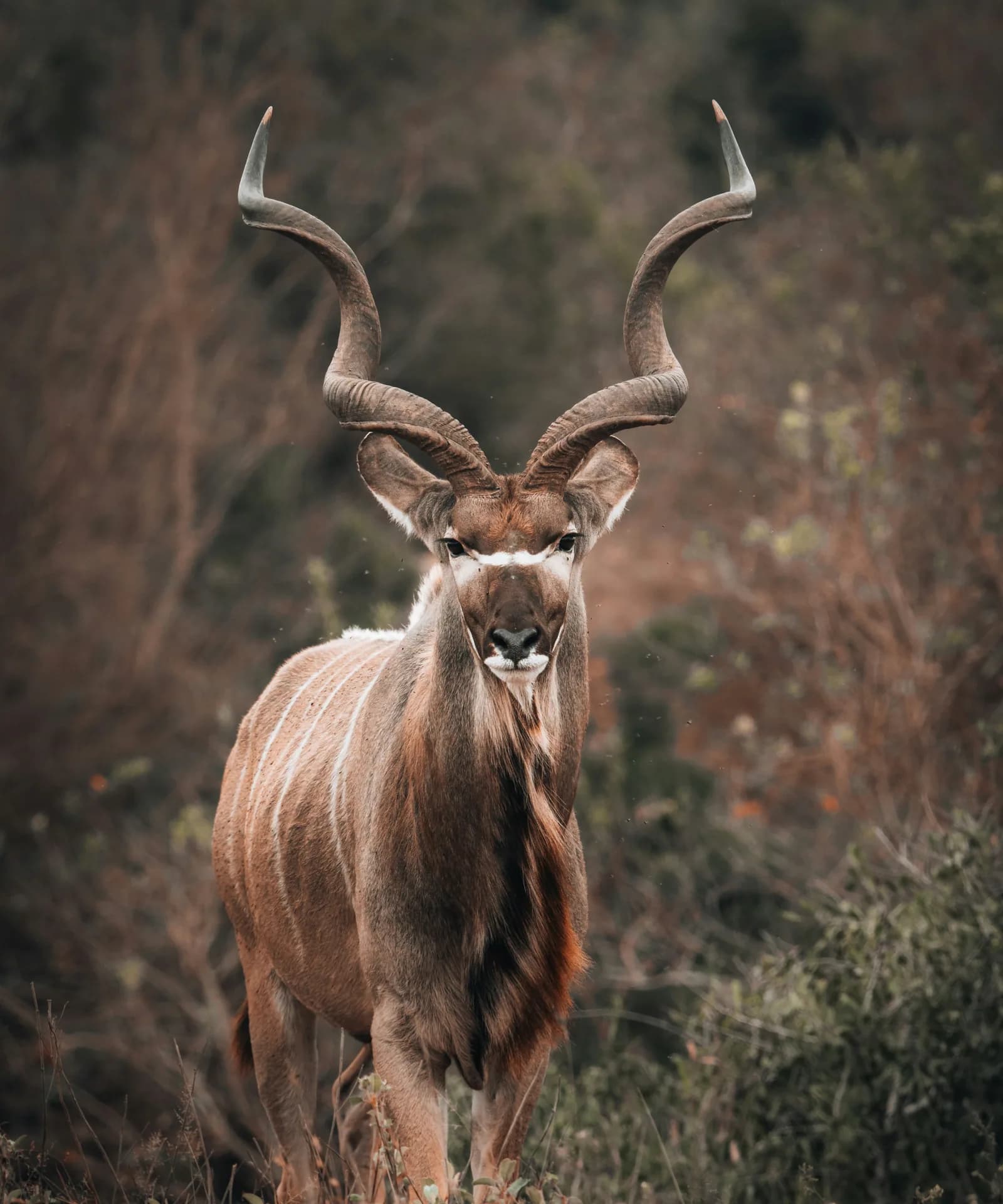
Body size is roughly double mountain reedbuck — 70–90 kg mature rams versus 22–30 kg. The coat is sandy to reddish-brown with paler underparts; distinctive dark markings run down the front of the forelegs. Only rams carry horns, which rise from the skull, curve back, and then hook forward at the tips — the forward hook is the species signature and what most trophy hunters notice first.

Two practical points define every common reedbuck hunt. First, the habitat controls the shot. Common reedbuck live in reeds, long grass, and papyrus-edge country. They feed out to the edges of reedbeds at dawn and dusk, then retreat back into cover as the day warms. Shots happen at the edge — often 40–100 m — with the animal standing at the transition between open grass and dense cover. Once the animal bolts back into the reeds, recovery becomes genuinely hard. Tracking a wounded reedbuck through 2 m reeds is slow, visually restricted, and sometimes unsuccessful. First-shot placement carries weight because of habitat, not body toughness.

Second, the whistled alarm call is the stalking signal. Common reedbuck alarm with a sharp two-tone whistle that carries through reedbeds. Hearing the whistle means you've been detected — usually with 5–10 seconds before the animal commits to flight into cover. The hunt often comes down to a shot during that window, from whatever position the ground allows.

Distribution in SA is concentrated along eastern watersheds and northern wetland zones. Core range is KwaZulu-Natal, eastern Mpumalanga, and the eastern Free State, with populations extending into parts of Limpopo and the Eastern Cape. They don't occur in the arid western interior.

Calibre is modest. .270 Winchester is comfortable, .243 Winchester is an acceptable floor with a premium bullet, and bullet construction matters less than placement. Anything heavier is unnecessary but not wrong.

Identification

Identifying common reedbuck

Common reedbuck are distinguishable from mountain reedbuck mostly by size, coat, and habitat — the two species rarely overlap, but both carry the Afrikaans name rietbok and some confusion does happen in transitional ground.

Both sexes share:

  • Sandy to reddish-brown coat with paler underparts and throat
  • Dark markings down the front of the forelegs — a species-distinctive field mark
  • Long ears with a dark external surface and a lighter interior
  • Short tail, dark on top with a white underside that flags visibly when the animal runs
  • Compact body with a slightly arched back

Rams:

  • Horns rising from the skull, curving back, then hooking forward at the tips (35–45 cm along the curve on mature animals)
  • Heavier neck and slightly darker coat than ewes
  • Hold small breeding territories on wetland fringes

Ewes:

  • Hornless
  • Lighter body mass (55–70 kg)
  • Often move in pairs or small family groups

Aging rams:

  • Young (1–2): horns short (under 25 cm), forward hook underdeveloped
  • Prime (3–5): horns 35–42 cm with clear forward hook and ridged bases
  • Old (6+): horns 40–45 cm with maximum forward hook; bases fully ridged, occasionally broomed tips

Common misidentifications:

  • Mountain reedbuck (Redunca fulvorufula). Distinguishing marks:
    • Size: common reedbuck 70–90 kg, mountain reedbuck 22–30 kg — roughly 3× the body mass
    • Coat: common reedbuck sandy-reddish; mountain reedbuck more grey-brown
    • Horns: common reedbuck forward-hook at the tips; mountain reedbuck simpler forward-curved horns without the same hook
    • Habitat: common reedbuck at wetland edges; mountain reedbuck on open hillsides
    • In transitional habitat where both could occur, defer to the PH and check horn shape
  • Waterbuck (young). On shared wetland properties, young waterbuck can briefly resemble a large common reedbuck. Waterbuck is much larger (young cow 180+ kg), has the distinctive white rump-ring, and lacks the forward-hooked horns
  • Oribi. Smaller, very different horn shape (short straight spikes on rams), different habitat (short grassland not reedbeds). Unlikely confusion at close range

Habitat

Where they’re found

Common reedbuck are wetland-fringe specialists. Distribution in SA tracks permanent water across the eastern watersheds and northern wetland zones.

South African distribution:

  • KwaZulu-Natal — coastal wetlands, midlands vleis, and the northern river systems. Core range
  • Mpumalanga — eastern Lowveld rivers, Highveld vleis, and wetland properties. Strong populations
  • Free State — eastern Free State vleis and river systems. Resident populations on suitable properties
  • Limpopo — wetland-associated populations along perennial rivers; less widespread than in KZN
  • Eastern Cape — selected river systems and wetland properties
  • Northern Cape, Western Cape, Gauteng, North West — marginal or absent; not core range

Habitat preferences within range:

  • Reedbeds and papyrus edges — the classic common reedbuck habitat. Dense vertical cover providing escape and daytime bedding
  • Vleis and flooded grassland — prime feeding habitat at dawn and dusk
  • Tall-grass riverine fringes — secondary habitat, especially where reedbeds are limited
  • Avoided: open short-grass plains, bushveld away from water, mountain slopes, arid country

Water dependence is absolute — common reedbuck require permanent wetland habitat and do not persist where surface water is seasonal only. This narrows their SA distribution significantly compared with generalist plains game.

Density is variable. Wetland properties that manage reed cover and water levels can carry substantial populations; over-burned or over-grazed wetland carries few reedbuck. Property-level habitat management is a bigger factor on reedbuck density than regional distribution patterns alone suggest.

Altitude range in SA is sea level to ~1,800 m. Highveld vleis at higher altitudes carry common reedbuck provided wetland habitat persists year-round.

Behavior

Behavior & herd structure

Common reedbuck social structure is loose. Rams hold small breeding territories on wetland fringes; ewes and young move through territories in pairs or small family groups of 2–5; larger aggregations are uncommon outside the rut.

Activity pattern: crepuscular — peak activity dawn and dusk when the animals move out of reedbeds to feed on the open fringes. Midday is spent bedded inside the reeds or in thick grass, invisible from outside. Night activity is moderate.

Rut: not sharply seasonal. Rams defend territories year-round, with somewhat heightened activity in wet summer months when cover is densest.

Behavioural traits for the hunter:

  • Whistled alarm call. The species signature. A sharp two-tone whistle carries through reedbeds and often announces that the animal has detected you. Hearing the whistle means 5–10 seconds before flight. The whistle is also useful as a location cue — reedbuck calling from inside cover tells the PH where to position for the evening feeding window
  • Bolt-into-cover response. Alarmed reedbuck run directly into the nearest reedbed or dense vegetation, not across open ground. This is the opposite of most plains-game behaviour. It makes the first-shot window short but also narrow — the animal goes into cover, not away from you across country
  • Stotting. Fleeing reedbuck sometimes stot (bouncing gait with all four legs off the ground at once) for the first few strides. Distinctive and visually obvious
  • Solitary or small-group pattern. Target identification on reedbuck is simple — there are rarely more than two or three animals to pick from in a group, and the ram is usually obvious
  • Feeding-out pattern. Common reedbuck exit reedbeds at specific points repeatedly — the PH knows the property's feeding-out points and positions accordingly
  • Territorial ram patrol. Rams patrol wetland-edge territory boundaries at dawn and dusk; a patrolling ram on open ground is a predictable opportunity window

Hunting

Hunting common reedbuck

Common errors:

  • Taking the shot at the reed edge without accounting for the bolt. A wounded reedbuck will make the reedbed in one or two bounds. Tracking through 2 m reeds is slow and visually restricted. Protocol: take the shot when the ram is clearly out on the open fringe, not at the reed-line itself; and take it from a position that gives you good recovery access
  • Confusing with mountain reedbuck. In transitional habitat or on properties that carry both species, body size and coat colour are the primary ID markers. Check before firing
  • Rushing the whistle window. The 5–10 second gap between alarm whistle and flight tempts hasty shots. A missed shot sends the animal into cover and ends the hunt. Take the shot when the hold is steady, not just when the clock is running
  • Under-calibre with a cup-and-core bullet. .243 is the floor but demands a premium bullet for reliable penetration on a 70–90 kg animal that may be facing into reeds. A standard .243 varmint bullet is under-gunning on a reedbuck ram
  • Ignoring wind into the reeds. Reedbuck use wind and reed-rustle together — a stalk with wind blowing toward the reeds alerts everything inside. Plan the approach with wind in mind

Distances. Typical shot is 40–120 m. Cover pulls shots close. 150 m+ is possible on open-vlei hunts but less common. Reedbuck hunts rarely involve long-range shooting.

Rifle setup. Floor is .243 Winchester with 95–100 grain premium bullet. Sweet spot is .270 Winchester with a 130–140 grain bullet. 7mm-08 Remington is a common and appropriate SA choice. Anything heavier is unnecessary but not wrong. Bullet construction matters more than sheer calibre on reedbuck because shots often angle into or along dense cover.

Zero 100 m with known drops to 200 m.

What to expect from your PH. Common reedbuck hunts are patient, often evening-focused affairs. Expect: mid-afternoon move to a glassing position near a known feeding-out point; wait for rams to exit the reedbeds 2–3 hours before dark; take the shot when the ram is clearly on open ground with good recovery access behind him. Morning hunts work similarly — position before first light near known feeding-out points, wait for the evening herd to return to cover. The PH will usually call the shot based on position relative to the reeds, not just on the shot angle.

Recovery on a well-hit reedbuck is usually within 30–80 m on open fringe or a short distance into the reeds. A poorly-hit reedbuck that makes the reedbed can be very hard to recover — a good first shot is the difference between an hour's work and a full-day track that may end without the animal.

Conservation

Conservation status

Common reedbuck are listed as Least Concern on the IUCN Red List. SA populations are stable across the species' natural range and expanding on private properties that manage suitable wetland habitat.

The species is habitat-dependent rather than harvest-dependent — hunting offtake across SA is modest and is not a population-level pressure on common reedbuck. The active conservation concerns are wetland conversion and degradation: drainage for agriculture, over-burning of reedbeds, and loss of river-system habitat to dam development all reduce common reedbuck habitat faster than harvest ever has. Properties that actively maintain reedbed and vlei habitat contribute directly to the species' stability regardless of whether they hunt reedbuck commercially.

SA private-land populations on well-managed wetland properties can be substantial. The species re-establishes readily where habitat is suitable, and re-introduction programmes have extended the species' presence on properties that previously held none. Public-land populations in KZN parks (iMfolozi, Ndumo) and parts of Kruger carry healthy reedbuck densities.

Common reedbuck and mountain reedbuck are separate species and do not hybridise in the wild — their habitats barely overlap. Record books (SCI and RW) score them as distinct categories. Hunters should be clear which species they are hunting, and properties that hold both should be explicit about which they are offering.

Shot placement

Where to place the shot

Always know your target anatomy before pulling the trigger. These are reference landmarks for ethical, humane kills. Conditions, distance, and animal posture change everything.

  • Broadside

    Heart-lung

    Landmark: Vertical line up from the back of the front leg, one-third up from the brisket.

    Standard plains-game broadside landmark. A .243-class premium bullet through this point anchors cleanly at reedbuck body size.

  • Quartering-away

    Heart-lung

    Landmark: Aim at the far-side shoulder joint. Entry through the near ribs behind the near shoulder.

    Workable at moderate angles with a premium bullet. Bullet path carries through both lungs and into the far shoulder for anchor.

  • Quartering-toward

    Heart-lung

    Landmark: Near-side shoulder joint, on the leg line.

    Workable at close range. The close distance on most reedbuck shots makes this a common and effective angle.

  • Frontal

    Heart-lung

    Landmark: Centre of the chest at the sternum notch where neck meets brisket.

    Available on a head-up ram during the alarm window. Premium bullet in .243 class or larger. Common and effective at 50–100 m.

  • Going-away

    No ethical shot

    Landmark: No landmark. A going-away reedbuck presents rump and gut and is usually about to enter reeds.

    Don't take going-away shots. The animal is typically bolting toward cover; a non-anchor hit results in a lost recovery.

  • High-shoulder anchor

    High-shoulder

    Landmark: Top of the shoulder blade, one-quarter down from the spine line.

    Useful when the ram is about to reach the reed-line and recovery is the concern. Breaks the spine and anchors in place. Destroys shoulder cape.

Available at

Farms offering common reedbuck

No farms currently offering this species on SkietNet.