
SkietNet
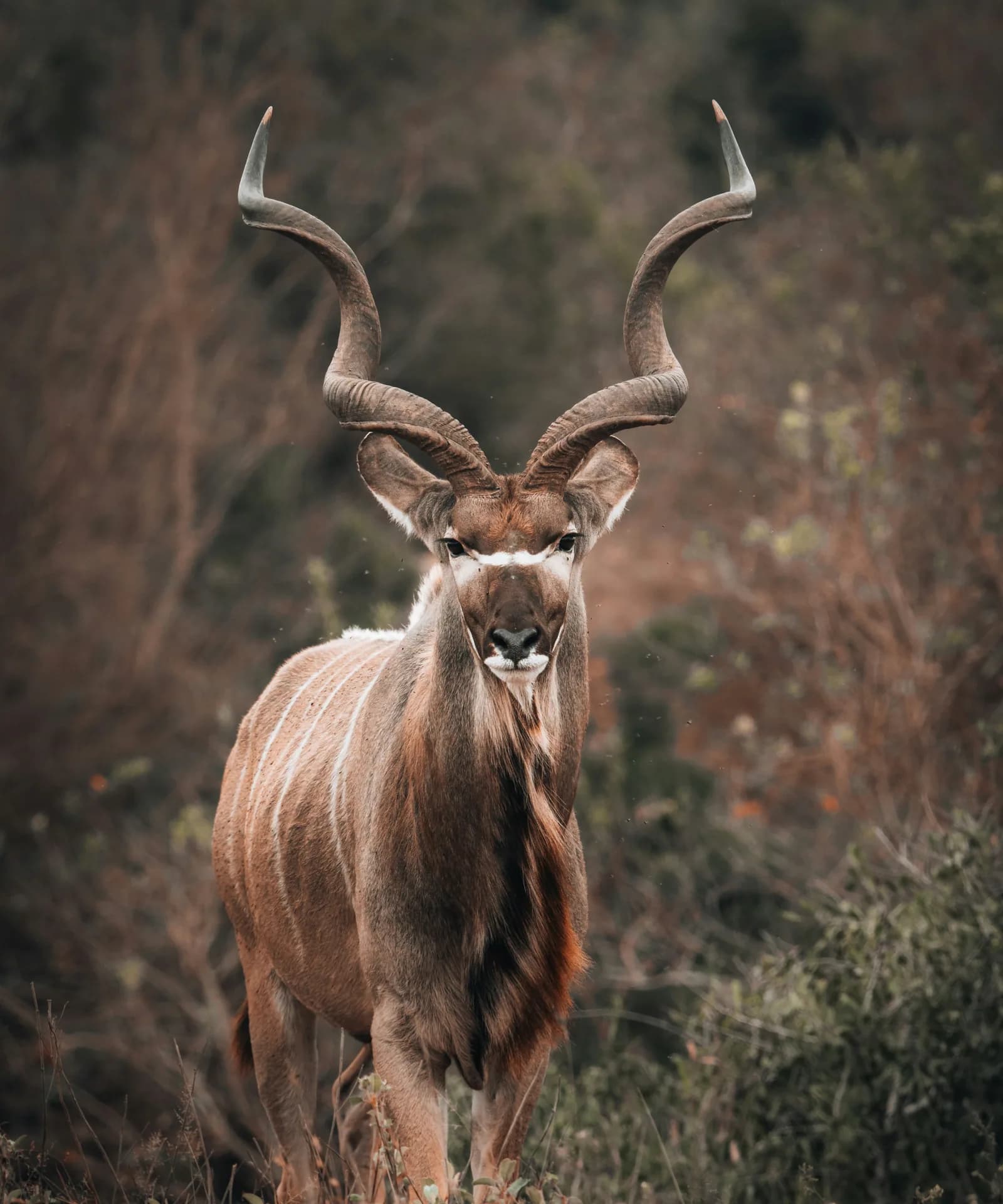
Bushbuck in natural habitat

Plains game

Bushbuck

Bosbok · Tragelaphus sylvaticus

The smallest spiral-horned antelope in SA — and the one with a documented record of putting horn through hunters who pushed a wounded bull too soon.

Overview

About the species

Bushbuck are the smallest spiral-horned antelope huntable in South Africa — 35–80 kg for mature bulls, 24–40 kg for cows. They’re also the most cover-dependent: riverine thicket, coastal forest edge, dense ravine country, thick acacia scrub on rocky hillsides. You don’t hunt bushbuck in open ground the way you hunt kudu, and you don’t hunt them at distance the way you hunt springbok. This is a 20–60 m stalk in cover so thick you’ll hear the animal before you see it.

The coat varies significantly across individuals and regions — bulls range from dark brown to near-black, cows from rufous chestnut to lighter tan, and both sexes show white throat patches and spots along the flanks. The pattern is broken-up camouflage that works devastatingly well in forest-edge cover; a bedded bushbuck at 30 m in dappled light can be invisible to an untrained eye. Bulls carry short, spiralled horns with a single full twist; cows are hornless.

The hunt is close, tight, and technically specific. Stalking discipline — wind, sound, stillness, stopping movement the instant the animal looks your way — matters more here than on any other plains-game species. Bow hunters favour bushbuck because the stalking distances are bow-friendly, and blinds over game trails at dawn and dusk produce consistently on well-managed properties.

One more thing you have to know before the first hunt: bushbuck bulls are aggressive when wounded. This isn’t folklore — there are documented incidents in SA and neighbouring countries of PHs and hunters gored by bulls that were approached too soon after a hit. The animal is small but the horns are sharp, the aggressive response is certain, and the cover hides the recovery. Section on wounded-animal protocol in the hunting part of this article is not decoration.

South African range centres on the eastern half of the country where thick cover exists. KwaZulu-Natal from the coast to the midlands, the eastern Cape, the Limpopo Lowveld river systems, and the Mpumalanga Escarpment river country all hold wild populations. They’re absent from the arid west, the Highveld grasslands, and anywhere lacking dense mid-storey cover.

Identification

Identifying bushbuck

Bushbuck identification is about silhouette and cover-adapted markings. Most hunters see a flash of dark movement behind a branch before they see a whole animal.

Bulls:

  • Dark brown to near-black body coat in mature animals; younger bulls stay reddish-brown longer
  • White throat patch (distinctive across both sexes)
  • White spots along the flanks and a row of white markings on the upper hindquarters
  • White crescent marking behind the ear on most individuals
  • Short spine crest of black hair, raised when alarmed
  • Horns: short, single spiralled twist, with cream-ivory tips on mature animals. 30–45 cm along the spiral. Base circumference modest by any other spiral-horned standard

Cows:

  • Rufous chestnut to light tan body coat — dramatically brighter than bulls
  • Same white throat patch and flank markings as bulls, but against the lighter body they’re more visible
  • Smaller body (24–40 kg)
  • No horns

Aging bulls in the field is coat-depth-and-horn work. Young bulls (1–3 years) carry rufous coats still shifting toward dark; prime bulls (4–6) are dark brown with full horn development and cream tips; old bulls (7+) go near-black, often with gnarled bases and broomed tips.

Common misidentifications:

  • Nyala cows — in thick cover at close range, a nyala cow (rufous chestnut, hornless) can be mistaken for a bushbuck cow. Nyala cows are larger (55–68 kg vs bushbuck cow 24–40 kg), longer-legged, and carry stripes rather than just spots. Bushbuck cows have a shorter, stockier silhouette
  • Young nyala bulls (12–24 months, still in their chestnut coat) — similar confusion in reverse. Young nyala bulls are notably longer-legged and larger-bodied than a bushbuck bull of any age
  • Grey duiker — different species entirely, smaller, no spots, different face structure. Unlikely to confuse but mentioned because both species share the same thick-cover habitat in coastal KZN
  • Bushpig at dawn/dusk — both dark, both in thick cover, similar size. Bushbuck have a thinner body, longer legs, and carry the head higher; bushpig are stockier and lower-slung. Bushbuck are huntable at dawn; bushpig are mostly nocturnal

Habitat

Where they’re found

Bushbuck are cover specialists. They need dense mid-storey vegetation within a water-accessible range, and they occur wherever that combination exists in South Africa’s eastern half. The arid west is not their country.

South African distribution:

  • KZN — coastal forest through the midlands — core SA range. Coastal forest edge, Zululand riverine bush, and Drakensberg foothill thicket all carry strong populations
  • Eastern Cape — eastern and coastal areas — widespread in the Great Fish and Keiskamma river systems and the coastal bush
  • Limpopo Lowveld — river system corridors — Kruger-bordering private properties along the Olifants, Letaba, Luvuvhu rivers
  • Mpumalanga Escarpment and Lowveld — riverine and ravine habitat on Kruger-adjacent properties and the escarpment forest
  • North West and Gauteng fringe — limited populations in suitable riverine habitat
  • Free State, Northern Cape, Western Cape — largely absent; occasional introduced populations on suitable properties but not native range

Habitat preferences within range:

  • Riverine thicket — the prime habitat. Dense stands of sycamore fig, fever tree, jackal-berry, and the associated mid-storey shrubs. Moisture, cover, browse diversity all present
  • Coastal forest edge — where the forest meets grassland or thornveld. KZN coastal forest is the classic bushbuck country
  • Ravines and kloofs — steep-sided broken country with thick vegetation, especially on escarpment and foothill terrain
  • Dense acacia scrub — transitional habitat where thorn-and-combretum mosaic meets thicker cover

Avoided: open grassland, arid shrubveld, any habitat that lacks dense mid-storey cover, deep sand areas.

Water dependence is moderate to high. Bushbuck don’t range far from water; the riparian bias is strong. Altitude range is sea level (KZN coast) to around 1,800 m (Drakensberg foothills); they handle cold well as long as cover is available.

Behavior

Behavior & herd structure

Bushbuck social structure is loose-to-solitary. Mature bulls are almost exclusively solitary outside brief breeding interactions; cows are typically solo or with a single calf; young animals (1–2 years) sometimes run in pairs. Unlike kudu or impala, you’re almost never stalking a herd — you’re stalking individual animals, usually following recent sign.

Activity pattern: strongly crepuscular with significant nocturnal activity. Peak daylight movement is first 45 minutes of light and the last 45 minutes before dark; mid-day is spent bedded in cover. Night activity is substantial — they feed through much of the night in productive habitat — but not relevant for daylight hunting.

Rut: loose, year-round breeding possible with soft peaks rather than hard seasons. SA populations show more breeding activity in early winter (April–June) but bulls are reproductively active year-round and territorial overlap is fluid.

Behavioural traits for the hunter:

  • Freeze response in cover. Bushbuck that sense something wrong freeze rather than bolt. A bull 30 m away behind a tree stem, perfectly still, will let you walk past him if you don’t look in the right spot. Scan through shade patterns, not around them
  • Bark. A deep, dog-like single bark when alarmed. A barked bushbuck ends the hunt on that individual for the day — they melt into cover and won’t present again
  • Game trail fidelity. Individual bushbuck use the same set of game trails to move between bedding and feeding areas for weeks or months. Blinds positioned over these trails at dawn and dusk produce reliably on properties where the trails are known
  • Wounded-animal aggression. The single most important behavioural trait for safety. A wounded bushbuck bull, especially one stopped but still alive, will gore hunters who approach too soon. Documented incidents in SA and Zimbabwe of PHs and clients gored. Always back off after a suspected bad hit, give the animal 30–45 minutes to die or bed down for good, approach from uphill with a second hunter covering, weapon ready, never alone
  • Low tolerance for repeated pressure. A property that hunts its bushbuck hard in one season will see the survivors shift to thicker cover and go more nocturnal next season. Good operators rotate bushbuck hunts across drainages

Hunting

Hunting bushbuck

Bushbuck hunting is close-cover stalking and blind work. The two productive methods are walk-and-stalk along riverine drainages at first and last light, and ambush from blinds positioned over known game trails or water access points.

Distances. Typical shot is 20–60 m. Bow hunting inside 25 m is common from blinds. A 100 m shot on a bushbuck is unusual and almost always means the animal has stepped out of its usual cover. Past 120 m is genuinely rare.

Rifle setup. Calibre floor is .243 Winchester / 6mm Creedmoor with a 90–105 grain premium bullet — a genuine floor, not aspirational. A .270 Winchester / 6.5mm class with 130–140 grain bullet is the sweet spot for SA bushbuck work. Over-calibre doesn’t hurt much because distances are short, but bullet construction matters more than calibre choice: dense riverine cover means shots occasionally clip twigs, and a controlled-expansion bullet will hold together through light brush where a cup-and-core soft-point can deflect or grenade.

Bow hunting is genuinely productive on bushbuck and is often preferred by hunters willing to sit blinds. 50 lb+ draw, fixed-blade broadhead of at least 125 grain, shots inside 30 m.

What to expect from your PH. The bushbuck hunt pace is slow and tight. Expect: pre-dawn start, walk to a known drainage or blind, spend significant time still or nearly so, watching cover patterns for the first movement of an animal. The PH’s value is in reading recent sign (tracks, dung freshness, browse damage), knowing which drainages hold which bulls, and positioning for the shot window you have — not the shot window you want.

Common errors:

  • Rushing the shot in thick cover. The window opens for 3–5 seconds as the bull steps between two shrubs. The temptation to snap a shot is strong. Don’t — an unprepared shot through a tight gap is how twigs get hit and bullets get deflected. If you’re not ready, let the animal pass and wait for the next gap or the next morning
  • Pursuing a wounded bull immediately. Back off. Wait 30–45 minutes. Approach uphill, slowly, with a second hunter covering and weapon ready. The documented goring incidents all share the same pattern: wounded bull that looked dead but wasn’t, hunter approached solo, horns in first. Don’t be in that pattern
  • Under-reading the cover. Visitors from open-country hunting reflexively look for animal silhouettes and miss the bedded bushbuck 25 m away in shade. Scan through shade patterns — look for the white throat patch, the horizontal line of the back, the ear flick. Don’t look for the whole animal
  • Shooting without confirming bull vs cow at close range. Short distances feel like they should make sex ID easy but the cover actually makes it harder — the bull’s white markings look like a cow’s, the horns are short and often obscured. Wait for the horn tips to clear cover before committing
  • Taking a shot on a walking bull. Bushbuck don’t move in the open the way antelope do. If you see a bull walking at 40 m, it’s crossing a gap that will close in seconds. Shoot when he’s stopped and squared up, or wait for the next presentation

Conservation

Conservation status

Bushbuck (Tragelaphus sylvaticus, the southern bushbuck) are listed as Least Concern on the IUCN Red List. The recent taxonomic split divides the species into Kewel (T. scriptus) in West and central Africa and southern bushbuck (T. sylvaticus) in southern and eastern Africa; the SA animal is the southern species. No CITES listing.

SA populations are stable to increasing on private land where suitable cover exists. The species’ strict cover requirements mean bushbuck numbers can’t be increased simply by reducing hunting pressure — what matters is preserving the riverine thicket, coastal forest edge, and ravine habitat they need. Properties that clear bush for cattle grazing lose bushbuck; properties that maintain or restore cover keep them. Trophy hunting economics on the private-land side are a direct positive for cover preservation on this species.

Annual offtake on SA properties is modest by impala or springbok standards. Bushbuck breed at a moderate rate — single calves typically, two per year possible — and the habitat specificity means density is inherently lower than open-country species. Trophy harvest of mature bulls on managed properties stays well below recruitment.

Subspecies and taxonomic note: historically bushbuck were considered a single species (Tragelaphus scriptus) with many subspecies. The 2000s and 2010s molecular work split them into two species (Kewel and southern bushbuck). SCI and Rowland Ward scoring categories are still organised around geographic type rather than the molecular split; the "Cape bushbuck" record category covers the SA southern subspecies. Minimums are reasonable enough that well-managed properties produce record-book trophies consistently.

Shot placement

Where to place the shot

Always know your target anatomy before pulling the trigger. These are reference landmarks for ethical, humane kills. Conditions, distance, and animal posture change everything.

  • Broadside

    Heart-lung

    Landmark: Vertical line up from the back of the front leg, one-third up from brisket line. Standard spiral-horned antelope position, scaled for bushbuck’s smaller body.

    Most common bushbuck shot given the close distances. A .243 / 6mm-class premium bullet through this landmark kills cleanly; bullet construction matters more than calibre because of cover-deflection risk. Don’t rush — wait for a clean gap with no twigs crossing the shot line.

  • Quartering-away

    Heart-lung

    Landmark: Aim at the far-side shoulder joint. Entry through the near ribs behind the near shoulder.

    Common presentation from a blind as a bull walks the approach trail. The angle carries through both lungs into the far shoulder; at typical 20–40 m distances even a modest calibre penetrates reliably. Use a premium bullet for cover-deflection insurance.

  • Quartering-toward

    Heart-lung

    Landmark: Near-side shoulder joint. Angles through the near lung into the off-side rib cage.

    Viable at close cover distances. Don’t take this shot if there’s any twig or branch crossing the near-side shoulder line — deflection into gut is the recovery scenario you most want to avoid on a species that gores wounded.

  • Frontal

    Heart-lung

    Landmark: Centre of the chest at the sternum notch where neck meets brisket.

    Available on a stopped, head-up bull at close range. The chest is modest and a .270-class bullet penetrates cleanly. At 30 m this is a high-percentage shot if you can find the sternum notch in available light.

  • Going-away

    No ethical shot

    Landmark: No landmark. Cover, distance, and the species’ wounded-animal aggression combine to rule out going-away shots.

    Never take a going-away shot on bushbuck. A wounded bull disappearing into thick cover is the exact scenario that produces the documented goring incidents. If the bull turns or stops, take a proper broadside; if not, let him go.

  • High-shoulder anchor

    High-shoulder

    Landmark: Top of the shoulder blade, one-quarter down from the spine line. Breaks upper vertebrae.

    Matters more on bushbuck than on most small plains game because anchor-in-place shots reduce the wounded-animal recovery scenario that is most dangerous on this species. On a bull that presents clearly at 30 m, consider this shot — it destroys the cape but eliminates the follow-up-into-cover problem.

Available at

Farms offering bushbuck

No farms currently offering this species on SkietNet.