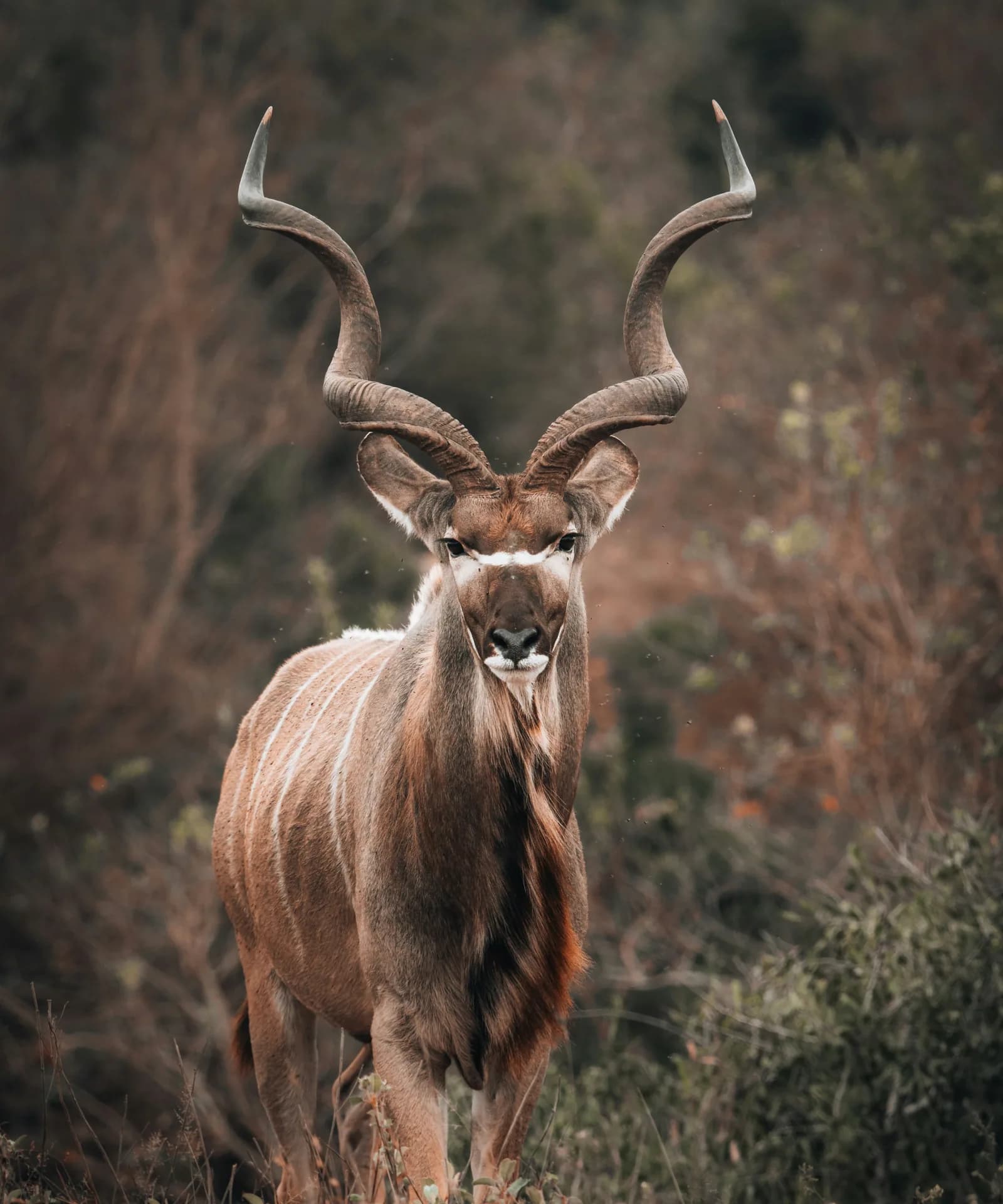

Plains game
Bontebok
Bontebok · Damaliscus pygargus pygargus
IUCN Vulnerable. Recovered from near-extinction through Bontebok National Park and managed breeding — a distinct subspecies, not a colour morph of blesbok.
Overview
About the species
Bontebok are the most conservation-sensitive plains-game species in the SA trophy catalogue. IUCN lists them Vulnerable, they are endemic to the Western Cape fynbos biome, and their recovery from near-extinction is one of the genuine managed-conservation success stories in SA wildlife history. This is not a species to hunt casually — it's one where the permit, the property, and the trophy record each carry documentary weight.
The recovery story, stated plainly: bontebok were hunted to the edge of extinction through the 19th century as settler agriculture and unregulated hunting consumed their fynbos habitat. Widely-cited historical accounts place the surviving population at approximately 17 animals on one Overberg farm by the early 1930s. Bontebok National Park was established in 1931 specifically to protect that remnant, and deliberate breeding programmes on public and private land over the following 90 years rebuilt the population to several thousand today across the Western Cape and into selected game ranches beyond the natural range. That figure is still small by plains-game standards. A managed hunting quota exists and the species remains CITES-regulated.
Two practical points define every bontebok hunt. First, this is a distinct subspecies, not a colour morph of blesbok. Bontebok (D. p. pygargus) and blesbok (D. p. phillipsi) share a species but diverge enough in appearance, habitat, and conservation status that record books score them as separate categories and reject intermediate phenotypes. Hunters planning a bontebok trophy should confirm the property's provenance — the genetic-purity question is real, documented, and checked at trophy-entry time.
Second, the shoot itself is similar to blesbok. Body size is comparable (60–80 kg rams), habitat is fynbos and grassy Cape renosterveld, and the calibre profile is identical: .243 Winchester or .270 Winchester with a standard bullet, shots typically 100–200 m across open ground. What differs is the documentation, the price tag, and the number of properties that hold bontebok at all.
Distribution in SA is tightly restricted. Natural range is the Overberg and southern Cape fynbos zone. Most hunt-able populations are in that zone on managed game ranches; a smaller number of introduced populations exist on Eastern Cape and Free State properties that hold documented-provenance animals. Trophy fees are substantially higher than blesbok.
Identification
Identifying bontebok
Bontebok are distinguishable from blesbok on close inspection but the distinction at distance or on mixed-genetic properties is genuinely difficult. This ID matters more than on any other SA trophy species because record books reject intermediates.
Both sexes share:
- Deep chocolate-brown to purplish-brown coat — noticeably darker than blesbok's lighter chestnut-brown
- White face blaze from forehead to muzzle, UNINTERRUPTED — this is the key ID marker vs blesbok, which typically shows a broken blaze with a dark band between the eyes
- Extensive white underparts running from between the front legs, across the belly, and up onto the flanks — much more white on the body than blesbok
- Pure white rump patch (pygarg) — larger and whiter than blesbok's
- White legs below the hocks — blesbok legs are lighter-coloured but not as crisply white
- Lyre-shaped horns with full ring-ridging — similar shape to blesbok, often slightly heavier at the base on mature rams
Rams:
- Heavier ridged horn bases — 8+ cm basal circumference on mature animals
- Darker overall coat with age
- Obvious male genitalia at close range
Ewes:
- Thinner horn bases with less ridge development
- Slightly lighter body mass (55–70 kg)
- Often similar horn length to rams
Aging rams:
- Young (1–2): horns short (under 25 cm), thin-based
- Prime (3–6): horns 35–42 cm with heavy basal ridging
- Old (7+): horns 40–45 cm, bases fully ridged and sometimes merged; tips often broomed
Common misidentifications:
- Blesbok (D. p. phillipsi). The critical ID. Key markers:
- Coat: bontebok deep chocolate with purple sheen, blesbok lighter chestnut-brown
- Face blaze: bontebok uninterrupted, blesbok typically broken by a dark band between the eyes
- White underparts: bontebok extensive up the flanks, blesbok confined to the belly
- Rump patch: bontebok larger and whiter
- Legs: bontebok white below the hocks, blesbok lighter but not white
- Hybrid or intermediate phenotypes. On some properties with mixed genetic history, animals show characteristics of both subspecies. Record books (SCI and RW) reject these for entry and require documented provenance. If a property cannot provide provenance documentation, a trophy may not be eligible for the bontebok record-book category
Habitat
Where they’re found
Bontebok are Western Cape fynbos and renosterveld specialists. Natural range is among the most geographically restricted of any SA trophy species.
South African distribution:
- Western Cape — Overberg and southern Cape — core natural range. Bontebok National Park, De Hoop Nature Reserve, and surrounding managed private land
- Western Cape — Cederberg foothills and Swartland — introduced populations on selected game ranches
- Eastern Cape — introduced populations on some game properties with documented provenance
- Free State, Northern Cape, KwaZulu-Natal, other provinces — introduced only in very limited numbers on properties with documented provenance; not core range
Most SA bontebok hunts happen on Western Cape or Eastern Cape game ranches that maintain resident breeding herds with documented genetic provenance.
Habitat preferences within range:
- Coastal fynbos — the natural habitat. Medium-height shrub-grass mosaic on coastal plain
- Renosterveld — grass-rich shrubland that carries bontebok well
- Managed pasture with fynbos-mix forage — common on private game farms
- Avoided: forest, mountain fynbos at high elevation, arid Karoo, bushveld
Water dependence is moderate. Bontebok drink daily when water is available but can draw moisture from succulent fynbos plants.
Altitude range in SA is sea level to around 1,200 m. The natural range is coastal plain; introduced populations on higher-altitude properties can do well if the habitat is suitable.
Habitat restriction is genuine and not just administrative — bontebok do less well on non-fynbos habitat over multiple generations, which is one reason re-introductions outside the Western Cape are carefully managed.
Behavior
Behavior & herd structure
Bontebok social structure centres on territorial rams and nursery herds. Rams defend breeding territories on open fynbos or pasture, nursery herds of 6–15 ewes with young move through territories, and bachelor rams form loose aggregations at the periphery.
Activity pattern: diurnal with morning and late-afternoon feeding peaks. Midday is spent bedded in light shade or on open ground with long sight lines. Night movement is minimal.
Rut: concentrated January–March in Western Cape populations. Territorial rams vocalise, patrol their ground, and fight — rutting rams are slightly easier to locate and more predictable than outside the rut.
Behavioural traits for the hunter:
- Long alarm distance. Bontebok have excellent eyesight and prefer open habitat where long sight lines detect approaching hunters at distance. A herd at 300 m will often already know you're there
- Standing-watch posture. On alarm but not yet committed to flight, bontebok stand facing the threat with ears forward. This is the opportunity window — 20–45 seconds typically — before they run
- Short-distance retreat. On committed alarm, bontebok run 200–500 m before stopping to re-assess. Shorter flight distance than tsessebe or hartebeest. Second-chance opportunities on the same herd exist but aren't guaranteed
- Territorial ram posture. Dominant rams patrol open ground, often pausing to mark territory boundaries or watch for rivals. A ram standing prominent on slightly higher ground or on a fynbos-mound rise is a likely territorial animal
- Alarm snort. Sharp nasal snort followed by head-up posture. Often the first audible cue on a stalk
Hunting
Hunting bontebok
Common errors:
- Misidentifying a bontebok / blesbok intermediate. On properties with mixed genetic history, animals can carry characteristics of both subspecies. A hunter shooting what looks like a bontebok on a property without documented provenance can end up with a record-book-ineligible trophy. Protocol: ask about provenance before booking; let the PH make the bontebok / blesbok / intermediate call before the shot
- Antelope-default behind-shoulder aim. Bontebok vitals sit slightly forward in the chest — not as dramatically as hartebeest, but enough that a kudu-default middle-of-body hold rides high and rearward. Landmark: leg line, one-third up from the brisket, slightly forward of centre
- Confusing bontebok with blesbok on mixed properties. Some Western Cape properties border or contain blesbok populations. Coat colour, face blaze, underpart white, and rump patch are the ID markers — check all four before firing
- Paying bontebok trophy fees for a non-pure animal. Trophy fees for bontebok are substantially higher than blesbok. Getting charged the bontebok rate for an intermediate is an expensive and preventable error
Distances. Typical shot is 100–200 m on Western Cape fynbos properties. Open-country shots can stretch to 250 m on some Overberg properties. Cover-pulled shots under 80 m are uncommon.
Rifle setup. Floor is .243 Winchester with 90–100 grain premium bullet — genuinely adequate on 70 kg animals. Sweet spot is .270 Winchester / .308 Winchester with 130–150 grain standard or premium bullets. Heavier calibres are unnecessary but not wrong. Bullet construction matters less than on larger species; a cup-and-core .270 is a competent bontebok rifle.
Zero 100 m with known drops to 300 m. Most shots are off sticks in standing or sitting position.
What to expect from your PH. Bontebok hunts are patient open-country glassing-and-stalking affairs. Expect: early start for morning feeding, glassing known herds the PH recognises by sight, careful age and pure-phenotype calls before a shot is green-lit. PHs on accredited bontebok properties take provenance seriously — trust the selection process. Paperwork at recovery (trophy tag, provenance certificate) is standard and should be in the client's hunt file.
Recovery on a well-hit bontebok is usually within 50–100 m. On open fynbos a poorly-hit animal can run 500 m+ before stopping, and the habitat can make tracking harder than it looks.
Conservation
Conservation status
Bontebok are listed as Vulnerable on the IUCN Red List. They are the only plains-game species in the standard SA trophy catalogue carrying that status. The species is listed under CITES Appendix II, and export permits for bontebok trophies require specific paperwork that a hunter's PH and outfitter should handle as part of the hunt package.
The recovery story, stated plainly. Bontebok were hunted to near-extinction through the 19th century as Cape agriculture and unregulated hunting consumed the fynbos habitat. By the early 1930s the surviving population was widely reported at roughly 17 animals on one Overberg farm. Bontebok National Park was established in 1931 specifically to protect that remnant. Deliberate breeding and translocation programmes across the 20th and 21st centuries — combining public-land protection with private-land breeding under provenance controls — rebuilt the population to several thousand today. The species is not recovered to historical density, and the range remains small, but it is no longer at immediate extinction risk.
Managed hunting's role is genuine and worth stating plainly. Trophy-fee economics on bontebok make the species financially worthwhile for Western Cape game properties to breed and protect, and those properties invest in fynbos habitat management specifically to sustain the herds. That isn't the same as saying hunting caused the recovery — public-land protection and scientific breeding were the main drivers — but hunting has been a functional part of the species' continued stability in recent decades.
Genetic-purity management is the active conservation concern. Bontebok (D. p. pygargus) and blesbok (D. p. phillipsi) are the same species, and they interbreed freely where ranges overlap. Hybrids and intermediates are not scored by any record-book, and widespread hybridisation dilutes the genetic integrity of the bontebok population. Responsible properties keep bontebok and blesbok on separate paddocks or separate properties, document breeding-group provenance, and decline to market hybrid animals as bontebok. Hunters should ask about separation and provenance before booking. Record books (SCI and RW) both have explicit rules rejecting intermediates for the bontebok category.
Shot placement
Where to place the shot
Always know your target anatomy before pulling the trigger. These are reference landmarks for ethical, humane kills. Conditions, distance, and animal posture change everything.
Broadside
Heart-lungLandmark: Vertical line up from the back of the front leg, one-third up from the brisket. Slightly forward of centre for a heart-anchor hit.
A .243-class standard bullet through this point anchors cleanly at typical fynbos distances. Middle-of-body hold is high.
Quartering-away
Heart-lungLandmark: Aim at the far-side shoulder joint. Entry through the near ribs behind the near shoulder.
Workable at moderate angles. The angle carries through both lungs and into the far shoulder for anchor.
Quartering-toward
Heart-lungLandmark: Near-side shoulder joint, on the leg line. Angles through the near lung into the off-side chest.
Workable at close range on calm animals. Pass in crosswind or at distance.
Frontal
Heart-lungLandmark: Centre of the chest at the sternum notch where neck meets brisket.
Available on a stopped head-up ram during the standing-watch alert. Standard bullet in .243 class or larger.
Going-away
No ethical shotLandmark: No landmark. A going-away bontebok presents only rump and gut.
Don't take going-away shots. Wait for the herd to turn.
High-shoulder anchor
High-shoulderLandmark: Top of the shoulder blade, one-quarter down from the spine line.
Useful when the herd is about to run into dense fynbos where recovery is slow. Breaks the spine and anchors in place. Destroys shoulder cape.
Available at
Farms offering bontebok
No farms currently offering this species on SkietNet.